
Transforming Your Garage with Interlocking Tiles
Explore the benefits of interlocking tiles for your garage, from easy installation to aesthetic appeal, and discover how they can transform this often-neglected space into a functional and attractive area.
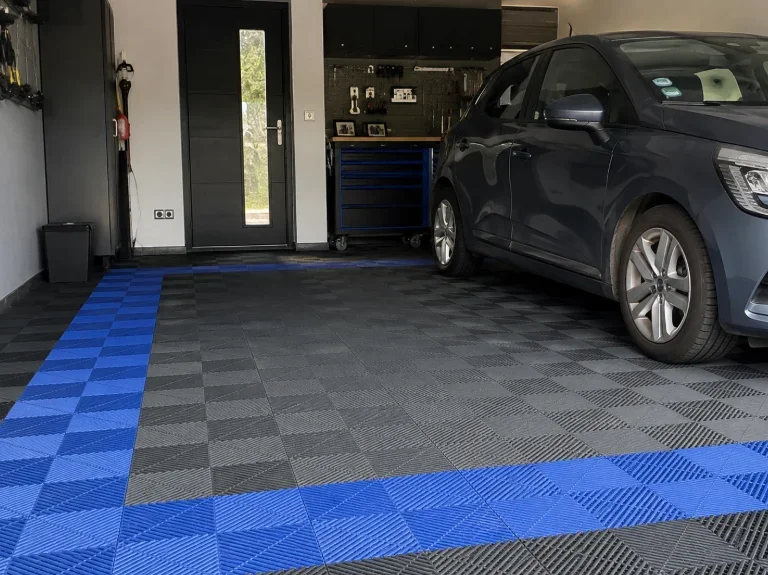
A garage often serves as the neglected part of a home, primarily used for parking vehicles, storing boxes, and occasionally engaging in DIY projects. However, with just a few hours of effort, this space can be completely revitalized using interlocking tiles—no glue, no joints, and no need for professional help. The real question isn't whether to do it, but rather why it hasn't been done sooner.
There are numerous advantages to consider: aesthetic appeal, floor protection, thermal comfort, and resistance to stains and heavy loads. Unlike epoxy paint or traditional tiling, these tiles can be easily dismantled and taken with you when moving. This solution is increasingly favored in both personal garages and professional workshops.
| Criteria | Interlocking Tiles | Raw Concrete | Epoxy / Floor Paint | |-------------------------|--------------------|---------------|---------------------| | Installation | A few hours, no tools | None (existing) | 2 to 3 days + drying | | Load Resistance | 25 to 32 T/m² | Variable | Good but fragile to impacts | | Maintenance | Vacuum + mop | Difficult (stains) | Regular cleaning | | Reversibility | Dismountable, reusable | Irreversible | | | Cold Insulation | 18 mm thick | None | None | | Oil Stain Resistance | Excellent (does not penetrate) | Permanent marks | Good but may chip | | Lifespan | 5 to 15 years warranty | Indefinite but degrades | 3 to 7 years |
Eliminating Stains and Degrading Concrete
Raw concrete in a garage is not waterproof. Oil leaks, wet tire marks, and coolant spills penetrate the porous surface, leading to a floor that resembles a map of mechanical mishaps over the years. This isn’t just an aesthetic issue; the porous concrete can absorb ambient moisture, promoting capillary rise and accelerating deterioration.
Installing quality floor tiles effectively addresses these problems at their source. Polypropylene tiles are inherently waterproof; liquids either flow beneath the perforated tiles or remain on the surface of solid tiles for easy cleanup. Say goodbye to permanent stains and crumbling concrete that leaves dust on everything placed on the floor. Your garage can be maintained just like the rest of your home, using a vacuum and a damp mop.
Over time, concrete also deteriorates mechanically due to repeated vehicle traffic, tool drops, and freeze-thaw cycles. Microcracks develop, leading to chipping and crumbling areas. Interlocking tiles can cover these imperfections and prevent further damage without needing prior leveling work. This is one of the major advantages of the system: an imperfect concrete surface, with slight level irregularities, can easily accommodate 40 x 40 cm tiles that absorb these variations without warping.
Easy Installation for Everyone
This is perhaps the most convincing argument for those on the fence. Installing garage tiles requires no special skills, drying time, or professional assistance. Painting or applying epoxy resin necessitates surface preparation, waiting several days for drying, and accepting a permanent result. With interlocking tiles, it’s as simple as pressing each tile into place until you hear a click confirming the connection.
All you need is a measuring tape, a marker, a jigsaw for edge cuts, gloves, and safety goggles. No glue, no joints, and no drying time. A standard 40 m² garage can be completed in about 4 hours. That evening, you can park your car on it without any special precautions. This drastically changes the equation compared to a weekend of labor required by other solutions.
The interlocking mechanism works on all four sides of each tile, with a system molded directly into the polypropylene during manufacturing. There are no additional pieces to add or rails to install. If a tile gets damaged due to a tool drop or impact, only the affected tile needs to be replaced without disturbing the rest: a small hook provided with the order allows you to unclip the damaged piece in seconds. This modularity is unmatched by any other flooring solution.
Exceptional Load Resistance
It’s a common misconception that a plastic tile, even a thick one, can't withstand the weight of a vehicle. However, this assumption is clearly disproven by the facts. Swisstrax tiles, made from copolymer polypropylene and 18 mm thick, are rated for loads of up to 25 to 32 tonnes per m², depending on the range. In residential use, a 2-ton passenger car represents a minimal load.
This remarkable strength is why these tiles are also used in automotive showrooms, professional mechanical workshops, detailing centers, and high-traffic logistics areas. The polypropylene does not deform under the static load of jacks or stands and maintains its mechanical properties throughout its guaranteed lifespan. Unlike epoxy, the tiles do not peel, fade, or crack under temperature fluctuations, which is particularly important in garages subjected to seasonal temperature changes.
For garages used as workshops, with benches and heavy tools, solid tiles are preferable to perforated ones for better support and a more stable work surface. Choosing materials based on actual usage rather than perceived image aligns with general DIY garage renovation logic.
Slip Resistance and Cold Insulation
A wet concrete garage floor can be dangerously slippery. Whether it’s water from wet tires, condensation in humid weather, or accidental spills, polished concrete offers little traction. Polypropylene tiles are naturally slip-resistant, and their ribbed or perforated surfaces enhance this feature. You can walk on them when wet without the risk of slipping, which is crucial in a space where you frequently exit your vehicle with wet shoes.
The thermal comfort provided by these tiles is another tangible benefit often realized only after installation. Concrete conducts cold directly to your feet in winter; standing in a bare garage on cold concrete in January is uncomfortable. The 18 mm of polypropylene creates a genuine thermal barrier between the cold ground and the walking surface. This is not insulation in the regulatory sense, but the comfort difference is immediately noticeable, especially for those who spend time in their garage working on projects.
For particularly humid garages, the perforated Ribtrax tiles are specifically designed to allow air circulation beneath the tile, helping to dissipate moisture and dry out quickly after spills. Excess humidity in a confined space can adversely affect stored materials and walls, leading to issues like efflorescence when moisture accumulates for too long in a poorly ventilated room.
Aesthetic Appeal: Making Your Garage Visually Pleasing
Often, the desire for a visually appealing garage is what sparks the project, even if practical arguments later convince you. A garage with an attractive floor transforms the area entirely. It encourages better organization, more effective use, and extended time spent in the space. Interlocking tiles visually enhance the area far beyond what one might expect from a simple flooring solution.
Swisstrax offers eight colors and six different styles, allowing for creative combinations, distinct circulation zones separate from parking areas, or even a checkerboard pattern that reflects the colors of a favorite automotive team. Different models (perforated, semi-perforated, solid) can be mixed to tailor the floor to various uses: a perforated tile under the car to allow for drainage, and a solid tile in front of the workbench for a comfortable workspace. The outcome resembles more of a showroom garage than a simple storage area, providing a level of customization that neither tiling nor epoxy can match.
Moreover, unlike other flooring options, when it’s time to move or change your mind, you can easily disassemble everything and take it with you. The tiles are reusable indefinitely. For renters, this is the only solution that allows for an investment in a beautiful garage floor without leaving it behind for the next occupant.
FAQ on Interlocking Tiles for Garages
Can interlocking tiles be installed directly over existing tiles?
Yes, absolutely. Swisstrax tiles can be placed over any existing flooring: raw concrete, tiles, or old floor paint. The only precaution on slippery tiles is to consider a thin anti-slip underlayment to prevent the tiles from sliding during movement. On raw or rough concrete, this issue does not arise as the texture naturally grips the tiles through friction.
Are the tiles resistant to motor oils and garage chemicals?
Polypropylene is naturally resistant to most common chemicals: motor oil, brake fluid, antifreeze, fuel, and detergents. Spills can be cleaned up without leaving traces. For highly aggressive solvents (acetone, strong thinners), it’s best not to allow them to sit too long on the tile and rinse them off promptly. In typical residential garage use, such situations are rare and do not have lasting consequences.
What is the minimum area recommended to justify the investment?
There is no minimum area requirement. Even for 10 m², the investment is justified by the comfort and aesthetic gains. The cost per tile varies by range (from 4 to 15 euros per 40 x 40 cm tile), so the budget can be adjusted according to the area. For a standard garage of 20 to 40 m², the project is very accessible. The larger the area, the lower the unit cost when ordered in bulk.
Do the tiles support jacks and lifting stands?
Yes. The resistance to static load differs from rolling load resistance, but the thick 18 mm polypropylene absorbs the point loads from rolling jacks and stands very well. To avoid slight deformation at the point of a stand, it’s recommended to distribute the load over a small metal or wooden plate if lifting very heavy loads. In standard amateur mechanical use, such precautions are rarely necessary.
Can interlocking tiles be installed in a humid garage or one with rising damp?
The perforated tile range (Ribtrax) is specifically designed for humid garages: the ribbed profile allows air to circulate under the surface, preventing moisture accumulation and promoting quick drying. If your garage has significant rising damp, addressing the root cause remains essential alongside. The tiles do not eliminate humidity but manage its effects on the surface.