Understanding Chemical Anchoring: Drying Times Explained
Understanding the complexities of chemical anchoring and drying times is essential for ensuring strong and reliable fixations in construction projects. Learn about key factors influencing curing times.
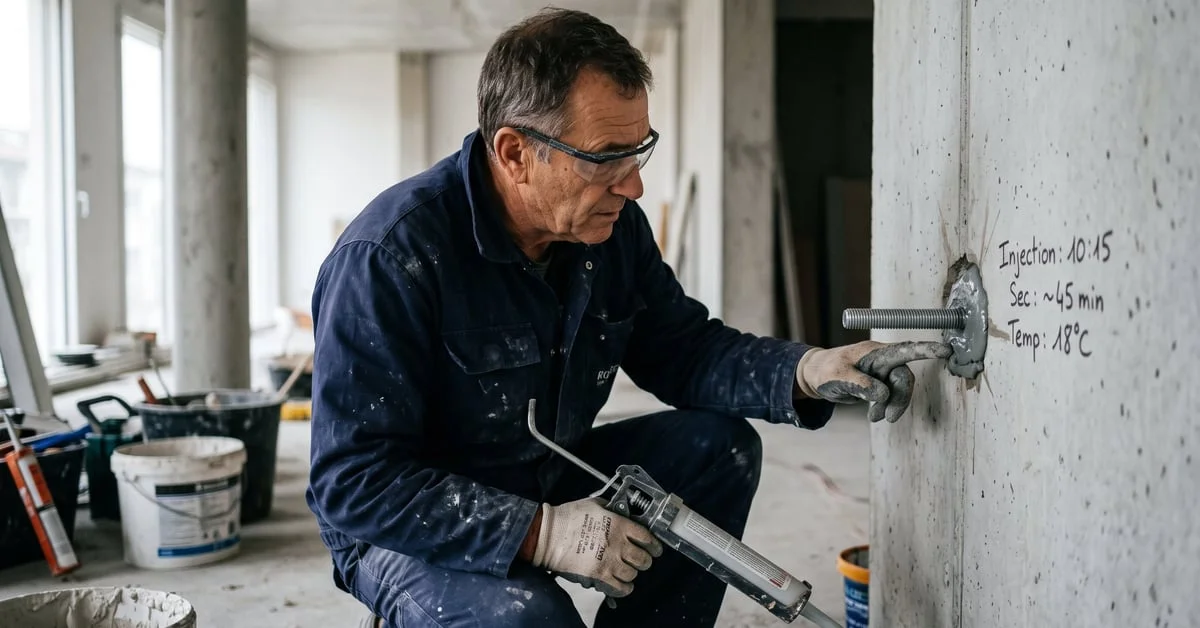
Applying a load too soon to a chemical anchor that is not fully cured can lead to a failure in fixation, often occurring weeks later without warning. One of the challenges is that the resin tube rarely specifies a single drying duration; manufacturers typically provide a range, which can be quite broad, and actual site conditions rarely mirror laboratory settings. Here’s how to interpret these data points and ensure successful anchoring.
Chemical anchoring relies on a polymerization reaction between two components—typically an epoxy or vinylester resin and a hardener. This reaction is not instantaneous and is influenced by several factors that can be anticipated. Understanding these variables allows for effective project planning without unnecessary risks.
⏱️ Key Concepts to Understand
Gel Time vs. Full Cure Time
Technical data sheets always present at least two distinct timings. First is the gel time (or open time), which indicates how long the resin remains workable after injection. The second is the full cure time, marking when the anchor can bear its nominal load.
In between these two is often an intermediate stage referred to as initial setting time—the resin may harden on the surface but remain soft internally. Tightening a nut during this phase can deform the still-malleable resin, leading to a reduction in load capacity by 30 to 50%.
⚠️ Important Reminder Never confuse gel time with full cure time. Placing a load after the gel phase but before full curing can drastically diminish the final strength of your anchor, often without any visible signs.
Handling Time vs. Full Load Time
Some products also differentiate between a minimum handling time (when you can remove the template or slightly stress the rod) and a full load time. For structural ties or guardrails, only the latter is significant. For simple decorative anchors, the former may suffice.
🌡️ Temperature: The Game-Changer
How Heat Accelerates Polymerization
The rule of thumb is straightforward: for every increase of 10 °C, the curing time is approximately halved. At +20 °C, a standard vinylester resin cures fully in 30 minutes. However, at +5 °C, you may need to wait between 3 to 6 hours depending on the formulation. Below 0 °C, most standard resins will not cure at all.
+10°C = curing time reduced by ~50% for most epoxy resins
Cold and Heat: The Two Pitfalls
In very cold conditions, using a winter-grade resin (like low-temperature vinylester) is the only viable option. These formulations can cure down to -5 °C, but the curing time extends to 8-12 hours. Conversely, in summer, be mindful of the opposite effect: at +35 °C, the open time can drop to just 2-3 minutes for certain products, making it challenging to work effectively. Opt for long gel time products or schedule work early in the morning.
| Temperature | Indicative Open Time | Full Cure Time | |-------------|----------------------|----------------| | +5 °C | ~30 min | 6 to 12 h | | +20 °C | ~6 min | 30 to 45 min | | +35 °C | ~2 to 3 min | 15 to 20 min |
Other Factors Influencing Drying
Humidity and Surface Condition
Moisture can significantly slow down the polymerization of epoxy resins. For instance, drilling a hole in damp concrete without allowing it to dry can double the curing time. Some vinylester resins are more tolerant of residual moisture, making them preferable for anchoring in excavated areas or basements.
A hole saturated with water (not just damp, but containing free water) should be blown out with compressed air and wiped dry. Failing to do so is a primary cause of failure in chemical anchoring in humid environments.
Type of Resin and Rod Diameter
There are two main families of resins available:
- Vinylester Resins: Quick setting, compatible with cracked concrete and cored drilling, but generally more expensive. Curing time is often 20-30 minutes at +20 °C.
- Epoxy Resins: Longer curing times (1 to 2 hours at +20 °C) with superior chemical resistance, ideal for heavy loads in corrosive environments.
- Polyester Resins: Entry-level products, less effective on cracked concrete, short gel time but lower final strength.
The diameter of the rod also plays a role. A thicker rod requires more resin to polymerize, which can increase the exothermic reaction heat, potentially accelerating curing locally. For M24 rods or larger, the rod itself can absorb heat and slow down curing.
💡 Tip Always refer to the technical data sheet of the specific product you are using, rather than a generic table. Companies like Hilti, Sika, Fischer, or Simpson Strong-Tie provide precise temperature/time charts for each reference, which are crucial if you are working under regulatory conditions (ERP, new construction).
🎯 Proper Anchoring Techniques
Correctly Preparing the Hole
Many professionals rush this step. A poorly prepared hole can negate all efforts regarding drying time. The correct sequence is as follows:
-
Drill to the Correct Diameter Adhere to the annular clearance specified by the manufacturer (generally 1 to 2 mm larger than the rod diameter). Too large results in insufficient resin; too small causes the rod to get stuck.
-
Thoroughly Clean Blow, brush, and blow again—at least three cycles. Concrete dust creates a non-stick layer that can degrade the anchor's resistance by 20 to 40%.
-
Inject the Resin from the Bottom Towards the Exit Fill 60 to 70% of the hole volume, insert the rod while rotating slowly, and allow it to cure without interference for the indicated time.
Verify Before Loading
The simplest test is to attempt to turn the rod by hand after the theoretical curing time. If it doesn’t move and the resin appears solid, it’s generally a good sign. For structural applications, a pull-out test with a dynamometer is the only truly reliable verification.
✅ Takeaway Site temperature, resin type, rod diameter, and surface condition collectively determine the actual drying time. The technical sheet provides a framework, while real conditions will adjust it. Always add a safety margin of 20 to 30% beyond the theoretical minimum before applying any load.
Long-Term Durability and Performance
What Happens After Full Curing
Once the resin is fully polymerized, the anchor reaches its maximum strength. Epoxy resins, in particular, may gain slight rigidity in the first 24 to 48 hours (a phenomenon known as post-curing). In practical terms, for common anchors, this difference is negligible. However, for precision anchoring (such as in industrial machines or overhead rail systems), some installers wait 24 hours even at +20 °C.
Durability then depends on the environment. When exposed to UV light without protection, epoxy resin can yellow and weaken the contact surface. In chemically aggressive environments (like fuels or weak acids), opt for high-strength epoxy or vinylester resins. The tensile strength of a well-executed chemical anchor in C25/30 concrete often exceeds 30 kN for an M12 rod—well above that of a comparable mechanical anchor in the same substrate.
For projects involving facade anchoring or seismic zones, also consult our resources on structural masonry fixings, where regulatory requirements add to drying considerations.
Can You Accelerate the Drying of a Chemical Anchor?
Gently heating the substrate (using a heat gun from a safe distance or infrared lamp) can speed up polymerization. However, be cautious: exceeding 40-50 °C on the surface may cause bubbles to form in the resin, reducing its final strength. Never heat the cartridge directly.
What to Do if the Resin Has Not Cured After the Indicated Time?
There are two primary causes: too low a temperature (reaction stalled, reheat the substrate) or improper mixing of components (clogged nozzle or insufficient static mixer). In the latter case, the resin remains tacky and soft—everything must be removed and restarted. The first few centimeters injected from a new cartridge should always be discarded, as the components are not yet correctly dosed.
Can Chemical Anchoring Be Done Underwater?
Some specialized products allow for this (underwater epoxy resins). Their curing times are significantly longer—expect 12 to 24 hours minimum even at normal temperatures—and they are considerably more expensive. Standard vinylester resins are not approved for underwater applications.
What Is the Lifespan of a Chemical Anchor?
Under normal conditions (indoors, without significant chemical aggressiveness), a well-executed anchor can last for several decades. European approval standards (ETA) test resins for lifespans of 50 years. The concrete surrounding the anchor often becomes the limiting factor before the resin itself.