Concrete Coping: Cost and Installation
Concrete pool coping stands out as a favored solution for homeowners looking to combine durability, aesthetics, and budget management. This article explores costs, installation tips, and essential considerations.
Concrete coping stands out as one of the most favored solutions among homeowners looking to combine durability, refined aesthetics, and budget management. Often relegated to a mere finishing detail, it actually constitutes one of the structural elements around a pool. Its installation affects user safety, protects the interior lining, and ensures visual coherence across the entire outdoor space. With numerous parameters to consider, including profile choice, optimal width, quality of implementation, and total anticipated costs, this article unravels the essentials, compares available options, and provides concrete benchmarks to proceed confidently with a project for installing or replacing reconstituted concrete coping.
- Reconstituted concrete coping has a competitive price, generally ranging between 40 and 90 euros per linear meter for supply only.
- Professional installation ranges from 32 to 125 euros per linear meter, including joints, depending on the complexity of the project.
- The standard width is between 28 and 35 cm, ensuring support safety and visual comfort.
- A drip edge profile is highly recommended to direct water away from the pool and protect the lining.
- The preparation of the support is crucial for durability: flatness, a slope of 1 to 2%, and flexible joints are non-negotiable.
- The maintenance of reconstituted concrete is accessible: gentle brushing, suitable cleaner, and periodic water repellent treatment are sufficient.
Concrete Pool Coping: Role, Functions, and Concrete Advantages
Coping refers to the peripheral crown of the pool, placed on the upper edge of the structure to ensure a clean finish, technical protection, and a walkable surface around the water. It is not an optional decorative accessory: without properly installed coping, the interior lining remains exposed to impacts, runoff water infiltration, and accelerated degradation of the edges.
From a safety perspective, reconstituted concrete coping has the advantage of being able to incorporate non-slip textures during manufacturing. These textures, often sanded or structured, maintain sufficient grip even when the surface is wet. Ratings R10 to R12 correspond to the most commonly used slip resistance levels around pools frequented by children or in intensive use.
Technical protection represents another central mission. The coping forms a continuous cap that covers the upper edge of the liner, shell, or plaster coating, preventing runoff water laden with dirt, leaves, or chemicals from entering the pool. This is where the so-called "drip edge" profile comes into play: a slight lip protruding under the coping that diverts runoff outward, rather than toward the pool.
Finally, the aesthetic aspect should not be underestimated. The coping defines the visual identity of the entire pool area. A well-chosen reconstituted concrete, in a shade harmonized with the terrace and facade, provides a coherent unity to the entire garden. Today, there is a very wide range of colors, profiles, and textures in molded concrete, allowing for the imitation of natural stone, wood, or smooth contemporary surfaces.
In summary, investing in quality coping simultaneously protects the pool structure, users, and the aesthetic value of the property. A detail that outdoor renovation professionals never overlook.
Cost of Concrete Pool Coping: Supply, Installation, and Overall Budget
The total cost of a coping project breaks down into several distinct items that should be anticipated separately to avoid unpleasant surprises during the project. Understanding this pricing structure allows for informed comparison of quotes and calibration of investment according to priorities.
Cost of Reconstituted Concrete Supply
For supplies only, reconstituted concrete offers one of the most accessible prices in the pool coping market. Depending on the profile, finish, and dimensions chosen, the price per linear meter generally ranges between 40 and 90 euros. The simplest models, with a flat profile and rounded edge, fall into the lower range. Versions with a drip edge, stone imitation finish, or wide formats (35 cm and more) tend to be positioned toward the higher end of this range.
In addition to this price, you must add the specific pieces: outgoing corners, return pieces, wall elements if a peripheral seat is desired. These elements are systematically more expensive per unit than straight modules. Also, plan for an additional material surplus of about 10% for cuts and project contingencies.
Installation Rates by a Professional
Labor often represents the most variable part of the budget. The installation of pool coping ranges from 32 to 125 euros per linear meter, including joints, depending on the region, the complexity of the pool (angles, freeform, integrated stairs), and the condition of the support to be prepared. A rectangular pool with a simple perimeter will be less costly to treat than a freeform pool requiring numerous cuts.
For a standard-sized pool (10 meters by 5), the perimeter for coping reaches about 30 linear meters. By combining supply and installation, the overall budget can therefore vary from 2,000 to 6,000 euros depending on the choices made. This figure remains indicative: only an on-site quote from a tiler or pool builder will accurately price the project.
Note: The installation also includes consumables often forgotten in initial estimates, namely deformable adhesive, peripheral flexible joints, spacers, and finishing treatment products. These seemingly minor items can represent several hundred euros on a medium-sized project.
Choosing the Right Profile and Dimensions for Concrete Coping
Selecting the profile is not merely a question of aesthetics: it determines the daily comfort of use, the safety of swimmers, and the ease of installation. Before ordering, it is useful to visualize how each profile will behave in the actual use of the pool.
Most Suitable Profiles According to Use
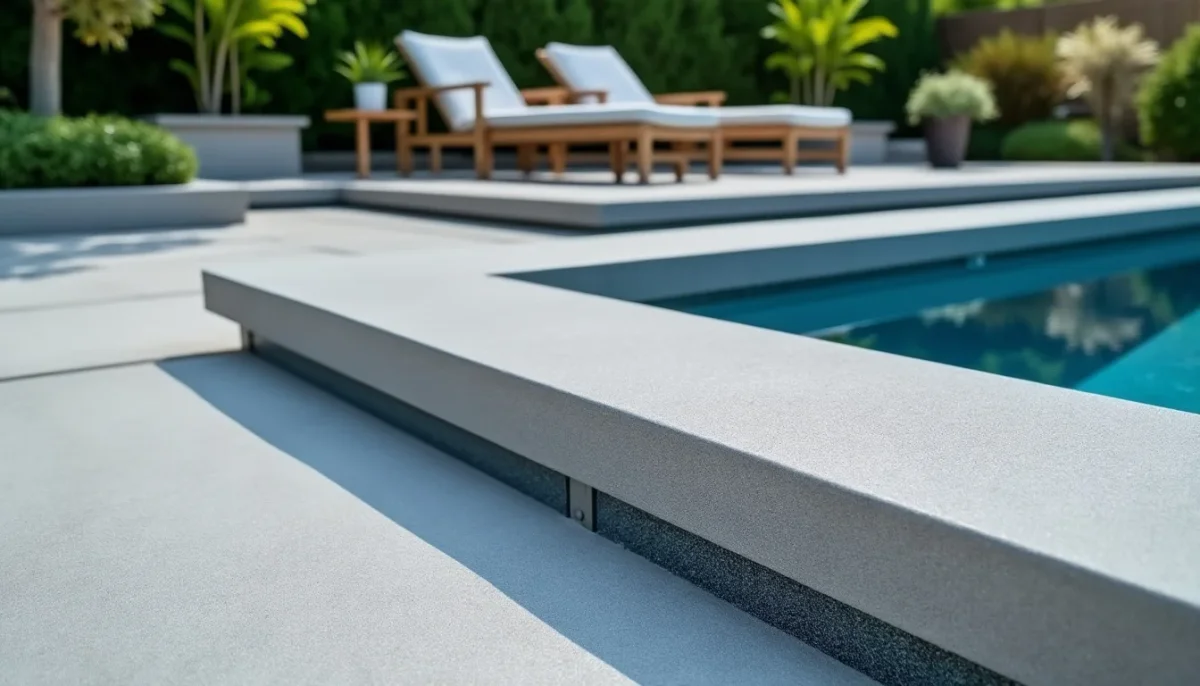
The flat profile with rounded edge is the most common choice: its clean line integrates into all architectural styles, its surface is easy to clean, and it facilitates grip when holding onto the edge. The profile with a drip edge, on the other hand, has a protruding lower lip that directs runoff away from the pool. This technical detail, often overlooked, makes all the difference in installations exposed to rain or watering of surrounding green spaces.
For families with children, a curved profile with a wide rounded edge offers better support comfort when exiting the water and reduces the risk of abrasion. The raised coping, forming a wall of 30 to 40 cm in height, creates a peripheral seat appreciated in sloped gardens or to visually mark the pool in an open space.
Standard Dimensions and Choices Based on Configuration
The recommended standard width is between 28 and 35 cm. Below 28 cm, the support surface becomes insufficient for exiting the water with stability. Beyond 35 cm, the coping may visually weigh down the pool line and complicate installation, especially in curves. The standard thickness for reconstituted concrete installed using the glued method varies between 3 and 4 cm, depending on the support's strength and the profiles chosen.
The drainage slope is a parameter often neglected: 1 to 2% towards the outside of the pool is sufficient to direct water away from the lining and avoid stagnation that encourages moss and stains. This adjustment is made during the preparation of the support, before any adhesive application. A mason's level and some temporary shims allow for precise inclination.
Budget Calculator
Concrete Pool Coping
Estimate the cost of your coping based on the perimeter, chosen profile, and installation method.
Pool Perimeter
Walk around your pool: length × 2 + width × 2
ml
8 ml120 ml
Coping Profile
Flat
40 – 60 €/ml
Drip Edge
55 – 75 €/ml
Curved
70 – 90 €/ml
Installation Method
DIY
Savings on labor
Hire a professional
Labor included
Include special pieces
Angles, half-rounds, rounded… Additional charge of +15% on the total.
Installing Concrete Pool Coping: Steps, Methods, and Pitfalls to Avoid
The durability of a concrete coping installation relies 80% on the quality of support preparation and the rigor of implementation. An excellent material installed on poorly prepared support will inevitably detach within the first few years. Here’s how to proceed to avoid this scenario.
Support Preparation and Step-by-Step Implementation
The first step is to check the flatness and solidity of the belt on which the coping will be placed. The surface must be clean, dust-free, and free of crumbling parts. If cracks appear or if areas sound hollow, they must be addressed before any adhesive application.
The adhesive used must be of type C2S1 or C2S2, meaning an improved and deformable mortar adhesive capable of absorbing micro-movements related to thermal variations. The double gluing technique, applying adhesive both on the support and on the underside of the coping, ensures maximum adhesion and reduces the risk of detachment.
Before starting the final installation, a dry run is essential: arrange all the pieces without adhesive to check alignments, angle cuts, and fittings. This step, often skipped by impatient amateurs, avoids costly mistakes that are difficult to correct once the adhesive has set.
The flexible joints between the coping and the terrace lining or the edge of the pool are essential to absorb expansions. An expansion joint every 3 to 5 linear meters is also necessary on long straight runs. These joints, often made with compatible polyurethane or silicone sealant, must be smoothed properly to ensure watertightness.
After complete drying (24 to 48 hours minimum depending on weather conditions), a surface water repellent can be applied to the reconstituted concrete to limit the penetration of water, oils, and sunscreen stains. This treatment significantly extends the aesthetic lifespan of the coping. For those wishing to learn more about protecting the pool surroundings, the question of installing outdoor aquatic equipment follows similar preparation and regulation logics.