
Eco-friendly Home: Costs and Construction Tips
Building an eco-friendly home is no longer a niche choice. This article explores costs, financial aids, and strategic tips for sustainable housing projects.
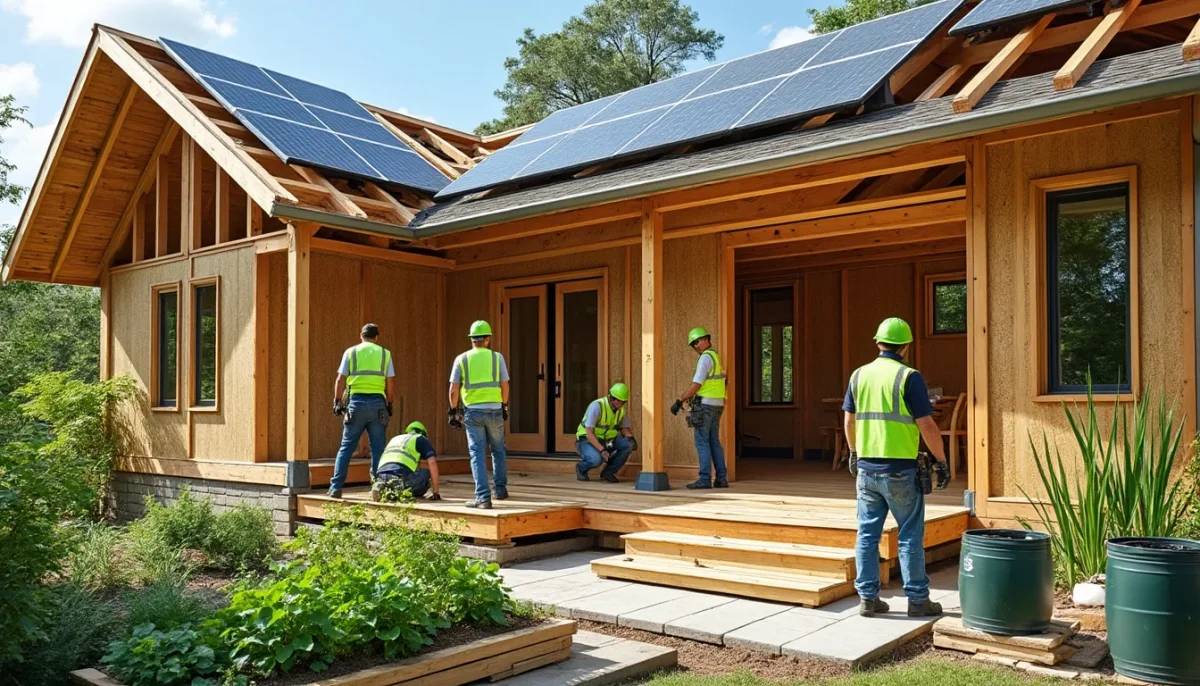
Building an eco-friendly home is no longer reserved for a militant fringe of the population. This lifestyle choice, once perceived as marginal, has become central to the most serious real estate projects. With the rise of regulatory constraints, soaring energy prices, and a rapidly changing collective consciousness, sustainable housing now meets very concrete expectations. But behind the allure of energy performance and bio-sourced materials, one central question remains: how much does an eco-friendly home really cost? The answer is far from simple. Price ranges vary widely depending on the materials chosen, the level of finish, the location of the land, and the degree of energy autonomy aimed for. A turnkey wooden frame project in a suburban area will have nothing to do, budget-wise, with a passive house built on clay land in a tight zone. It is within this complexity that the challenge of good planning lies.
- In brief:
- The average cost of an eco-friendly home ranges between €1,500 and €3,000/m², depending on the materials and performance level targeted.
- The wooden frame house represents an excellent cost/performance compromise, with an initial cost increase of 4 to 6% compared to traditional construction.
- Cumulative financial aids (PTZ, tax credits, local exemptions) can reduce the bill by several tens of thousands of euros.
- The architectural shape, area, and choice of local materials are the three main levers to control costs.
- Over 20 years, the profitability of an eco-friendly home relies as much on energy savings as on increased property valuation.
Understanding the Expense Items of an Eco-friendly Home: What the Price per m² Really Hides
Before diving into numerical estimates, it is essential to understand how the budget of an eco-friendly home is broken down. Unlike conventional construction, each technical choice has a direct impact on several items simultaneously. The land represents on average 15 to 30% of the total cost, a proportion that can rise well beyond that in attractive or tight zones. Purchasing a serviced plot also involves a soil study, the price of which generally ranges between €1,500 and €3,000 depending on the geological complexity of the site.
Next comes the design phase, led by a specialized architect or a thermal engineering firm. This step, often overlooked in quick estimates, absorbs between 8 and 12% of the overall budget. Yet, it determines the project's compliance with RE2020 and dictates a significant part of the building's final performance. Poorly anticipated, it can generate costly revisions during construction.
The structural work — foundations, load-bearing walls, framework, roofing — represents between 20 and 25% of the budget. This is where the choice of materials weighs most heavily. A well-designed wooden frame costs slightly more than a traditional masonry structure, but it offers a much more favorable carbon footprint and integrated natural insulation. Consider a fictitious project led by Thomas, a carpenter in Auvergne: by opting for a local wooden structure, he reduced his transport costs by 8% while enhancing the forest resources of his region.
Thermal insulation constitutes a distinct and strategic item, representing 10 to 15% of the budget. Bio-sourced materials — straw, hemp, wood wool — are favored for their performance and low environmental footprint. The finishing work (joinery, partitions, coverings) can vary between 20 and 25% depending on the level of finish chosen. Finally, technical equipment — double-flow ventilation, heat pumps, solar panels — often exceeds 15 to 20% of the budget, an item that is sometimes underestimated at the outset.
It is strongly advised to plan for a safety margin of 5 to 10% additional to address unforeseen construction issues. This financial cushion avoids many blocking situations, especially when the nature of the soil holds surprises — such as the discovery of a shallow water table that requires specific foundations.
The Often Underestimated Role of Land in the Total Budget
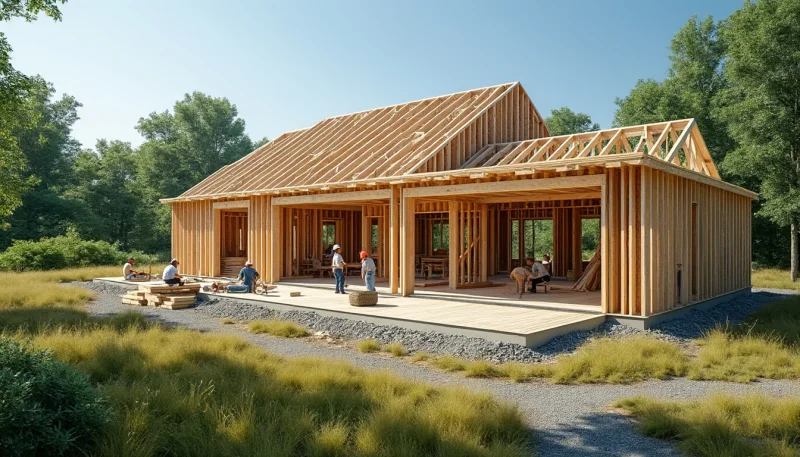
The nature of the soil is a determining factor that many project holders discover too late. In clay or wet areas, foundations require specific technical solutions: screw piles, reinforced crawl spaces, or widened slabs. These adaptations can represent an additional cost of €5,000 to €20,000 compared to standard foundations.
The orientation of the land also plays a key role in the bioclimatic performance of the future home. A well-exposed south-facing plot allows for maximizing passive solar gains in winter, thus reducing heating needs. This criterion, often ignored when purchasing the plot, can directly influence energy bills over several decades. It is safe to say that it deserves particular attention from the earliest stages of the project.
Wooden Frame House: An Initial Cost That Hides Real Profitability
Choosing a wooden frame house is today one of the most strategic choices in the field of eco-friendly construction. This type of building, whose cost generally ranges between €1,320 and €1,900/m² including tax, exceeds traditional masonry construction costs by 4 to 6%. However, this differential quickly fades in light of the savings generated over the long term.
The reduction in annual heating bills can reach 30%, thanks to integrated insulation in the structure, high-performance joinery, and rigorously executed air tightness. In addition, there is a higher property valuation of about 15% on the market, linked to compliance with current environmental standards and the growing demand for this type of housing. To better grasp the differences with a traditional house, this comparison between wooden and traditional houses sheds valuable light on the long-term maintenance stakes.
There are four main delivery formulas for a wooden house, each suited to a different profile:
- Self-construction kit: delivery of the bare structure, between €700 and €1,400/m². Reserved for experienced profiles with solid technical skills.
- Shell ready: structure installed and waterproofing ensured, between €850 and €1,300/m². Ideal for self-builders wishing to delegate the most critical phases.
- Ready to decorate: structural work completed and partial finishing work, between €1,400 and €1,800/m². A good compromise between autonomy and ease of execution.
- Turnkey: from €1,700 to over €2,500/m² for high-end custom work. Every detail is taken care of, from foundations to personalized finishes.
A 100 m² project can thus vary from €115,000 in kit form to over €240,000 for a high-end turnkey realization. Regardless of the format chosen, the ecological advantage and thermal performance remain constant. The key lies in choosing a competent professional: price differences between two equivalent quotes can reach 20 to 30%, resulting in very different outcomes.
To delve deeper into the reflection on constructive alternatives, exploring the price of a container house can offer an interesting perspective on other forms of innovative and economical housing.
Partial Self-construction: Reducing Costs Without Sacrificing Quality
Partial self-construction is a serious option for project holders with manual skills. Some tasks — lime painting, laying floor coverings, simple interior fittings — can be done without a professional, provided they are rigorously prepared. This approach can reduce the overall bill by 10 to 20% depending on the level of involvement.
However, caution is advised against false calculations: poorly executed tasks can lead to costly corrections. Air tightness, for example, is a critical point that cannot be improvised. It is better to delegate sensitive technical phases and focus on finishes where mistakes remain fixable. Successful self-construction is above all a reasoned and well-defined self-construction.
Aids and Financial Schemes: How to Concretely Reduce the Cost of an Eco-friendly Home
The landscape of public aids for eco-friendly construction has significantly expanded in recent years. The Zero Interest Loan (PTZ) allows financing up to 50% of the total project cost, provided it complies with RE2020. This aid, accessible under certain income conditions, represents a major financial lever for first-time buyers looking to build sustainably without excessive debt.
Other schemes complement this picture. Tax credits dedicated to thermal insulation and bio-sourced materials allow for recovering part of the investments made. Local and regional aids, often little known, frequently target the use of wood and short supply chains. Some municipalities also grant partial property tax exemptions for two to five years for constructions meeting strict environmental criteria.
By intelligently combining these schemes, it is possible to lighten the budget by €30,000 to €50,000 on a standard-sized project. This direct reduction in borrowed capital mechanically impacts monthly payments and the total cost of credit. The sine qua non condition to fully benefit from this: anticipate these procedures from the design phase and integrate administrative management into the project timeline.
Some regions also offer support in the form of free advice, through specialized structures in energy transition. These services, often underutilized, can prevent costly mistakes in assembling the financing dossier.
Anticipating Administrative Procedures to Avoid Missing Out on Aids
One of the most common pitfalls in eco-friendly construction projects is discovering too late the existence of certain aids or missing the application deadlines. Some schemes must be activated before the start of work, or risk permanently losing the right to the grant. A golden rule applies: never start a construction site without having finalized your financing plan.
Surrounding oneself with a real estate financing advisor or a study office specialized in eco-construction greatly facilitates this step. These professionals know the subtleties of the files and the sometimes-changing eligibility criteria. Investing a few hundred euros in quality support can yield several thousand euros in additional aids. A calculation that few project holders regret having made.
Optimizing Your Budget Without Compromising Ecological Performance: The Real Levers of Savings
Is it really possible to build ecologically without spending more than a conventional house? Not systematically, but several architectural and technical choices allow for containing costs while maintaining a high level of performance. The first lever is...