Understanding the Costs of Solar Panel Cleaning: Essential Insights
Solar panels require proper maintenance for optimal performance. This article explores the costs of cleaning, methods available, and factors influencing pricing to help homeowners make informed decisions.
Solar panels are a significant investment, and their maintenance is crucial for ensuring long-term profitability. Unfortunately, cleaning these panels is often overlooked, either due to a lack of knowledge about pricing or insufficient information about service providers. Homeowners with small installations and operators of large photovoltaic parks have vastly different needs, which is reflected in the pricing. Dust, pollen, or bird droppings can reduce the efficiency of a solar installation by 2% to 30%, leading to substantial energy and financial losses over the year. Understanding the costs, available cleaning methods, and factors influencing quotes can help homeowners make informed decisions without unpleasant surprises.
- In summary:
- Cleaning costs start at €8/m² for a standard residential installation.
- Professional cleaning can restore up to 20% of lost energy production.
- Three cleaning methods are available: manual, robotic, and drone, each suited to different types of installations.
- Recommended frequency is 1 to 2 cleanings per year, ideally in spring and autumn.
- Larger professional installations benefit from significant economies of scale, with prices dropping to €4/m².
- Factors like accessibility, level of dirt buildup, and geographical location directly influence the final quote.
Pricing for Residential Solar Panel Cleaning: Key Considerations Before Signing a Quote
For homeowners with around ten panels installed on their roofs, the question of cleaning costs often arises after noticing a drop in output from the inverter. The price range can be surprising if one has not taken the time to compare offers.
For a 3 kWc installation, which is the most common in individual homes, the price per square meter ranges from €8 to €10/m², leading to a total cost typically between €130 and €200, depending on the provider and region. A 6 kWc system incurs costs of €240 to €310, with a slightly lower price per square meter, around €7 to €9. For a 9 kWc setup, the range is between €350 and €420, making the surface/labor ratio more favorable.
Some professionals offer a unit price per panel, which can reach €75 excluding tax per unit. This billing method, less common, is particularly relevant for occasional interventions on hard-to-reach installations requiring meticulous cleaning.
It is also essential to clarify what the quoted service includes. Generally, the base price covers the cleaning of glass surfaces and a visual inspection of frames, fixtures, and seals. Any electrical diagnostics or inverter checks are considered additional services, costing between €80 and €100 excluding tax, depending on the provider.
A useful tip is to always request a detailed quote that outlines each item to avoid unexpected surcharges related to roof pitch or the need for scaffolding.
What Factors Increase Costs for Homeowners?
The accessibility of the roof is the primary factor affecting pricing adjustments. A steep roof with panels positioned high and difficult to access without specific equipment will invariably incur additional costs. The use of a lift or scaffolding adds significant charges for the service provider, which translates to higher costs for the client.
The level of dirt accumulation also plays a crucial role. Panels that haven't been cleaned for several years, covered in moss, lichen, or scale from non-demineralized water, require more time and sometimes the use of specific products. Routine cleaning is distinctly different from deep cleaning, and prices reflect this difference.
Geographical location also influences costs, especially in densely populated urban areas or regions far from major centers, where travel expenses are charged. In rural or mountainous areas, some providers apply travel fees that can represent 20 to 30% of the total bill.
Finally, proximity to the sea, agricultural dust, or busy roadways accelerates dirt accumulation and may justify a higher cleaning frequency, leading to a more substantial annual budget. Anticipating these additional costs when signing a maintenance contract can prevent many inconveniences.
Cleaning Prices for Professional and Agricultural Installations: Volume Discounts at Play
When transitioning from residential to professional cleaning, the pricing logic shifts dramatically. Larger areas treated allow for the amortization of fixed intervention costs and optimize the use of mechanized equipment, significantly reducing the cost per square meter.
For installations exceeding 30 kWc, the price per square meter drops to between €5 and €6/m², translating to a total investment of €1,200 to €1,800 for a complete cleaning. Installations above 50 kWc see prices between €4 and €6/m², with total costs ranging from €1,800 to €2,400. Photovoltaic parks with more than 100 kWc enjoy the most advantageous conditions, typically between €4 and €5/m², resulting in an investment of €3,000 to €4,200 for the entire site.
These savings stem from the pooling of human and technical resources. An operator cleaning 500 square meters in a single day optimizes their travel, time, and equipment, which benefits the client through reduced unit pricing.
For agricultural operators who have adopted agrivoltaics, maintenance management often falls under an annual contract, negotiated in advance for multiple interventions. This approach secures a fixed rate while ensuring regular maintenance visits, which is essential for stable energy yields.
Annual Maintenance Contracts: A Worthwhile Option
For both professional operators and homeowners with medium-sized installations, entering into an annual maintenance contract offers significant advantages. Hourly rates typically range from €15 to €75 per hour, or between €100 and €300 per year for a complete package.
Such contracts usually include two annual visits, a technical check of the inverter and wiring, along with a status report on the installation. The operator benefits from peace of mind and often a negotiated rate due to commercial loyalty.
The regularity of interventions is a performance factor that is often underestimated. A park maintained clean throughout the year produces energy more consistently and predictably, facilitating revenue management from resale or self-consumption. Maintenance is not a cost; it is a performance lever.
Cleaning Methods: Manual, Robotic, or Drone—Choosing the Right Technique
The term "cleaning" encompasses very different realities depending on the size of the installation, its accessibility, and the owner's performance ambitions. Each method has its strengths, limitations, and ideal contexts for use.
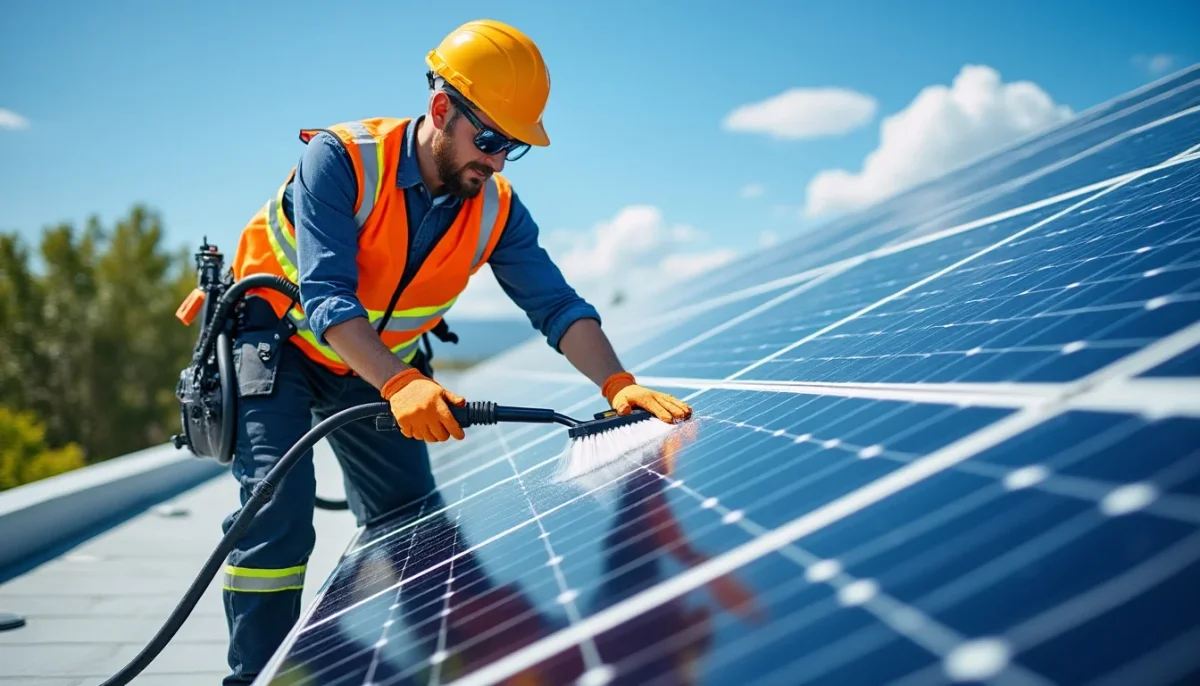
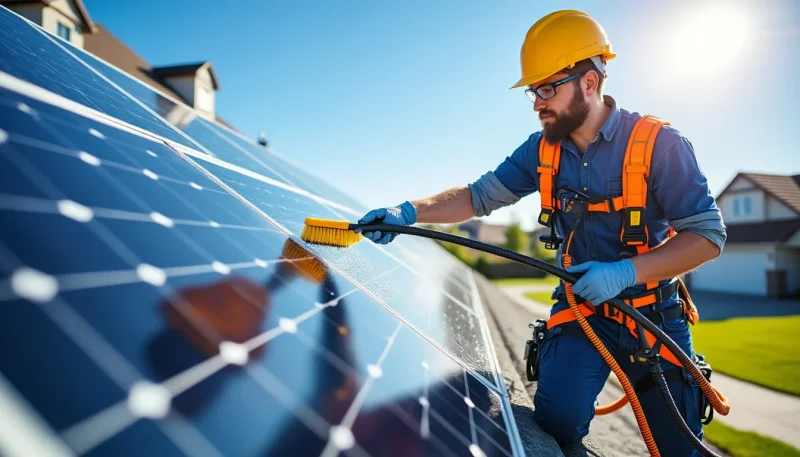
Manual cleaning remains the standard for small residential installations. A technician equipped with a soft broom, deionized or osmosis water, and a telescopic pole cleans each panel individually. This method ensures precise results, allows for detailed visual inspections of surfaces and fixtures, and is adaptable to all types of roofs. Its main drawback is the time required for large areas.
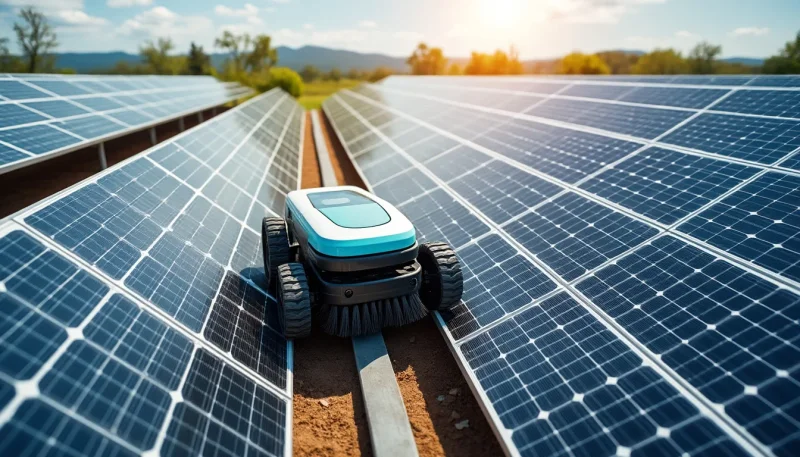
Robotic cleaning emerges as a credible alternative for medium to large installations. A programmable robot navigates the rows of panels, applying water and rotating brushes, covering large areas without direct human intervention. For a one-off service, costs range from €100 to €300 for a residential installation. If considering purchasing a robot for a large installation, prices range from €1,000 to €5,000, depending on the models and capabilities.
Drone cleaning represents the most recent innovation, particularly suitable for hard-to-reach rooftop installations or large ground-mounted parks. A drone equipped with a water nozzle or projection system can quickly cover extensive areas. Costs range from €500 to €1,500, depending on the complexity of the intervention. This technology is increasingly appealing to industrial park operators, who see it as a means to reduce risks associated with working at heights while maintaining maintenance schedules.
Deionized Water: A Technical Detail That Makes a Difference
Regardless of the application method, the quality of the water used significantly impacts the final outcome. Tap water, laden with calcium, leaves white streaks that diminish glass transparency and harm efficiency. Reputable professionals always use osmosis or deionized water, which dries without residue and preserves the integrity of glass surfaces.
This technical detail, often overlooked by non-specialists, can make all the difference between effective cleaning and an intervention that leaves the installation almost unchanged. Checking the use of this type of water when requesting quotes is a simple yet remarkably useful precaution.
The quality of cleaning is measured as much by the tools as by the method. A diligent provider will document their intervention with before-and-after photos and can provide a performance report after the visit. These elements serve as guarantees of professionalism and allow for objective comparisons of results from year to year.
The Profitability of Regular Cleaning: When Maintenance Becomes a Real Investment
The most frequently asked question is straightforward: is it really worthwhile to clean solar panels? The answer, supported by concrete data, is unequivocal.
A dirty panel can lose between 2% and 30% of its efficiency depending on the intensity and nature of the dirt. In areas with high air pollution, near agricultural sites or busy roads, degradation is often faster and more pronounced. A well-executed professional cleaning can recover up to 20% of energy production, representing a significant financial gain over the year.
For instance, consider an installation in Nantes, where average sunlight allows for reasonably calculable annual production. A 20% gain in efficiency could translate to approximately 360 kWh more per year, or about €50 in direct savings. This highlights the importance of regular maintenance as a strategic investment in maximizing solar energy output.