
Your Brain and Organization: Why Good Decluttering Plans Often Fail
Discover why decluttering plans often fail and how understanding the brain's mechanisms can help you create effective organization strategies.

And then the next day arrives – and suddenly the energy is gone. The plan feels heavy, the motivation is lacking, and instead of starting, everything gets pushed further ahead. This is exactly where the topic of brain and organization becomes interesting. Because often the problem lies not in laziness, lack of discipline, or character flaws, but in typical cognitive traps.
Those who delve into brain and organization quickly realize: Our mind loves the current state, even if it burdens us. Chaos can surprisingly become stable. The good news is equally important: What the brain has learned, it can also unlearn. And therein lies the key to making decluttering easier in the long run.
Why Decluttering Plans Disappear Overnight
Many know this strange feeling: In the evening, there’s suddenly clarity. You imagine how nice it will be tomorrow when everything is clean, free, and tidy. Perhaps real anticipation even arises. But the next morning, the same task feels unpleasant, exhausting, and far too large.
This is frustrating because you no longer understand yourself. Yesterday, you were confident it would work. Today, the same plan feels like an imposition. This is where looking at brain and organization helps, as it shifts the blame away from personal character to psychological mechanisms.
When a project repeatedly fails at this point, a negative cycle quickly develops:
- You plan with motivation.
- You do not implement it.
- You experience this as personal failure.
- The next task seems even heavier.
- You start planning again, but with less confidence.
Over time, the conviction solidifies: I can plan, but I cannot act. This conclusion is often incorrect. The real problem is not the person but the way the brain evaluates states.
The First Cognitive Trap: The Hot-Cold Empathy Gap
An important component in the topic of brain and organization is a psychological phenomenon that describes how poorly we can empathize with a different internal state. Simply put: When we feel good, motivated, or determined, we can hardly imagine that we will soon feel completely different. And when we are exhausted, sick, or overwhelmed, we can hardly envision that it will become easier again.
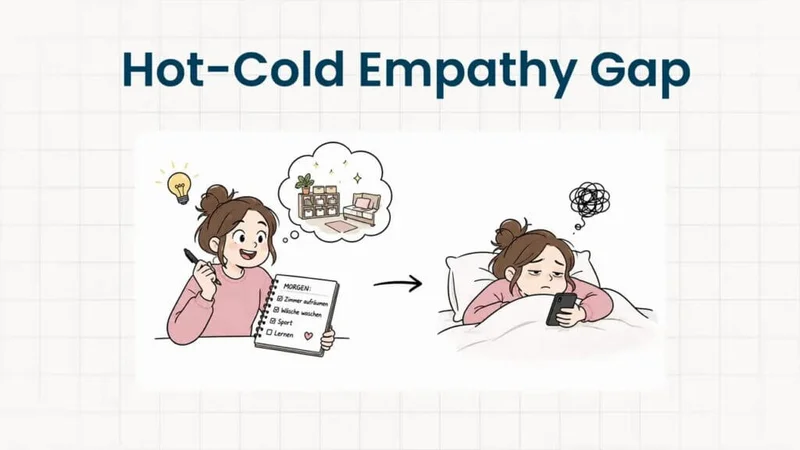
This happens constantly with decluttering plans. In the evening on the sofa, the situation is often calm. The pressure of the day is over, and the thought of tomorrow feels open. In this moment, it seems absolutely realistic to tackle several areas the next day: stove, oven, range hood, drawers, maybe even the pile of papers in the hallway.
The next day, the internal situation looks different. Fatigue, daily life, appointments, mental baggage – and suddenly the same plan seems exaggerated. The evening self and the morning self are in two different states. That’s why the task not only feels heavier but sometimes almost foreign.
This also explains why people in uncomfortable situations often believe that it will never get better. In pain, exhaustion, or illness, the brain can hardly recall a later better state. For brain and organization, this means: Those who are currently in chaos often cannot vividly imagine real relief.
The Second Cognitive Trap: The Focus Illusion
The next trap is at least as treacherous. Once the brain focuses its attention on a problem, that problem quickly appears larger and more absolute than it actually is. This distortion leads us to hold a fragment as the whole.
When standing in a messy kitchen, suddenly you see only used glasses, paper bags, crumbs, full surfaces, and leftover items. The brain conveniently ignores that other areas of the home might be quite tidy. The view no longer zooms out but sticks to the chaos.

For the interplay of brain and organization, this is immensely important. Because when the mind only stares at the problem, the situation seems final. A few bad corners become an internally perceived completely failed home. An area needing action turns into the feeling: Everything is too much.
And that’s not all. Once this perception dominates, the willingness to even start decreases. The brain does not register: Here are ten things lying around. It registers: This is unsolvable.
Why the Brain Clings to the Status Quo
The brain likes to save energy. This is not a flaw but an ancient principle. Everything that means change costs energy: deciding, touching, sorting, letting go, rearranging, reorganizing. So the mind prefers to cling to what currently is – even when the state is uncomfortable.
That’s why brain and organization is not just a practical topic but always also an energetic one. Disorder is often the known state. And the known state feels safer to the brain than change.
This is reflected in very typical thoughts:
- It is what it is.
- I won’t be able to complete it today anyway.
- If I rearrange everything, I won’t find anything afterward.
- It’s pointless if it will soon be chaotic again.
Additionally, there’s another psychological effect: People cling to what they already have – even if it is not objectively ideal. This applies to objects, habits, and states alike. The existing system receives an inflated value in the mind simply because it is already there.
Thus, burdensome disorder quickly becomes a defended normal state. This sounds paradoxical, but it is a core point in brain and organization: Not everything that is familiar is good. But much of what is familiar still feels easier than change.
Why Organization Cannot Simply Be Thought Into Existence
A particularly interesting point is the question of why the brain does not simply lure with the reward. One would think: If organization relieves, the mind should use this prospect to get into action.
Unfortunately, this often does not work that way. The reason is simple: You get used to everything. Those who live in disorder for a long time eventually experience it as the starting state. It is not beautiful, but normal. And what is normal is emotionally questioned surprisingly little.
Therefore, the good feeling after decluttering cannot always simply be summoned from nowhere. Those who hardly experience or store this relief consciously cannot use it as motivation. This is a central point for brain and organization: The brain can long for something familiar but hardly for a state it has not properly stored internally.
One could compare it this way: Explaining the taste of chocolate to someone who has never tried it will always be incomplete. You can find words, but the experience is missing. It is the same with genuine relief through organization. If this feeling is not yet anchored, “You will feel better afterward” sounds more like a claim than a real prospect.
How the Brain Can Learn Organization Anew
Here it becomes practical – and fortunately also hopeful. Because if the brain has not yet stored organization as rewarding, then it must learn exactly that. Not through force, not through huge mammoth actions, but through small, repeated successes.
In brain and organization, small is not a fallback but the actual strategy. The brain needs mini-steps to credibly store a new experience.
Well-suited examples include:
- a single drawer,
- the nightstand,
- the cutlery drawer,
- a small spice area,
- a jewelry box,
- a manageable surface.
The crucial point is not just the action itself but the conscious perception afterward. Those who have organized something small should not rush on immediately. It is better to pause briefly and truly observe the result.
This may seem surprisingly banal, but it is psychologically very clever: The brain should learn the connection between action and good effect. Only then does mechanical decluttering become a positive internal trace.

A helpful little trick is to step away briefly and then return later. Open the tidy drawer again. Look at the nightstand again. Feel the difference again. This way, the experience becomes more firmly anchored.
Those who are very visual can also take photos. A picture of the tidy kitchen, the organized drawer, or the clear bedroom helps later to visualize the other state again. Especially in the context of brain and organization, such images can act like little memory aids.
A Practical Approach for More Brain and Organization
What does this mean practically? Above all this: Big resolutions lose power when translated into small, credible steps. Instead of “Tomorrow I will do the whole kitchen,” a formulation like: “Tomorrow I will clear the countertop for ten minutes” or “I will only sort one drawer” is more helpful.
This may sound unremarkable, but it is often the turning point between failure and implementation. Because for brain and organization, credibility counts. A small step is more likely to be started. And a step that has been started can create a good feeling. From this, reliability gradually develops.
A possible process could look like this:
- Choose an area that can be done in a maximum of ten minutes.
- Tidy only that one area.
- Pause briefly afterward and consciously perceive the result.
- Possibly take a photo.
- Repeat this in the following days with other mini-areas.
Those who wish can also work with checklists. Especially small checkmarks help to make progress visible. The magazine of Ordnungsliebe offers suitable suggestions for this, and signing up for the newsletter is also a good addition for regular organizational motivation.
It is important not to tie your identity to disordered phases. Organization is not a matter of character. Those who struggle to start are not automatically lazy or negligent. More often, there is simply a lack of a stable internal connection between action and reward.
The better the brain learns this connection, the easier it will be later to reconnect even in worse phases. Then, while chaos may not be completely absent – it no longer feels final. And that changes a lot.
Rethinking Brain and Organization
Perhaps the most reassuring thing about all this is: The topic of brain and organization is not about becoming a completely different person. It is not about perfect discipline and also not about a rigid system that must always work. It is about a small internal reprogramming.
Those who understand why the brain clings to current states, why motivation fluctuates, and why chaos feels so quickly normal can treat themselves much more kindly. And those who then work with small, concrete successes gradually build a new experience: Organization feels good, is achievable, and can begin easily.
This way, frustration gradually turns into trust. Not through a big jolt, but through many small proofs that change is possible. And perhaps that is the most beautiful thought about brain and organization: Your mind is not against you. It just needs to learn how to work with you.