Cost Analysis of 200 mm Rock Wool for Insulation
Understanding the costs and benefits of 200 mm rock wool insulation for effective home energy efficiency.
Effectively insulating a home is currently one of the most profitable investments in the construction sector. Among the available materials, 200 mm rock wool stands out as a preferred choice for demanding thermal and acoustic insulation projects. Its pricing, fire performance, and durability make it a favored option for both professionals and informed homeowners. Understanding its cost per square meter, variations based on formats, and installation conditions can help anticipate a precise budget and avoid unpleasant surprises during the project.
In summary:
- The price for 200 mm thick rock wool ranges from €16.90 to over €30 per m² depending on format and quality.
- It has a Euroclass A1 fire resistance, making it non-combustible up to 1,000 °C.
- The thermal conductivity coefficient is around 0.039 W/m.K for kraft rolls intended for attics.
- Professional installation adds an average of €15 to €25 per m² depending on complexity.
- Financial aids like MaPrimeRénov’ can significantly reduce the final bill.
- Rock wool costs €2 to €5 more per m² than glass wool, providing superior acoustic and fire performance.
Price of 200 mm Rock Wool per m²: Understanding 2026 Rates
The thermal insulation market has seen notable price adjustments in recent years, influenced by rising energy and raw material costs. As of 2026, the price of 200 mm rock wool typically falls between €16.90 and €35 per m², depending on packaging, density, and intended use.
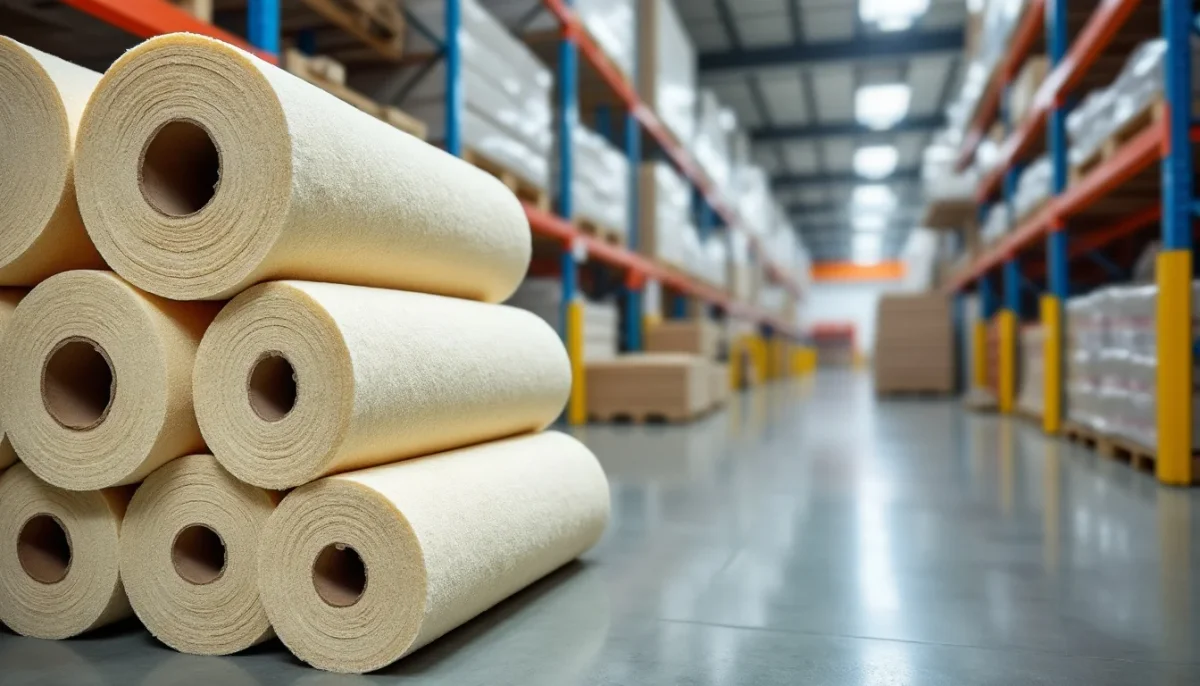
For rolls intended for lost attics, entry-level prices start around €16.90 per m², with packages generally covering about 14.40 m². This format is particularly suited for large horizontal surfaces where installation remains accessible without advanced technical skills.
Rigid panels, on the other hand, have a wider price range. For a thickness of 200 mm, costs can reach €28 to €35 per m² depending on the chosen density. A high-density panel designed for internal wall insulation or sloped roofs will naturally be more expensive than a flexible roll intended for unrenovated attics.
It’s important to note that rock wool typically costs €2 to €5 more per m² than glass wool for equivalent thermal performance. This price difference is justified by its distinct advantages: A1 fire resistance, better acoustic attenuation, and no long-term settling. For a sound insulation project in a ceiling, for instance, this extra cost quickly becomes negligible considering the benefits gained. Homeowners looking to enhance their living space's sound comfort can refer to specialized resources on ceiling sound insulation for further insights.
The blown rock wool used for hard-to-reach attics represents a different option: its cost, including labor, is estimated between €33 and €48 per m². This method requires specific equipment and professional intervention, which explains the significant labor component in the final price.
Factors Influencing Price per m²
Several elements directly affect the final cost of a 200 mm rock wool insulation project. The product density is the primary criterion: the higher the density, the more rigid and acoustically efficient the panel, but also more expensive. A density of 40 kg/m³ is suitable for partitions, while a density of 100 kg/m³ is necessary for terrace roofs or floors.
The packaging format also plays a significant role. Purchasing in bulk can amortize the unit cost. A contractor working on a 200 m² site will obtain much better pricing conditions than a homeowner ordering two rolls for a small attic.
The presence or absence of a vapor barrier, such as polyethylene kraft, also affects the price. This type of barrier, integrated directly onto the roll, simplifies installation and avoids the separate purchase of a vapor retarder. The additional cost is modest, but it exists.
Lastly, the geographical location of the site and the accessibility of the installation area impact the overall quote. A sloped roof in a densely populated urban area will involve a more complex and costly installation than an easily accessible lost attic in a single-family home.
200 mm Rock Wool for Attics: Performance and Value
Insulating attics is often the first project undertaken by homeowners looking to reduce energy expenses. This is because up to 30% of heat loss in an uninsulated home occurs through the roof. The 200 mm rock wool effectively addresses this issue.
With a thermal conductivity of approximately 0.039 W/m.K, this material achieves a thermal resistance R of around 5.1 m².K/W for a thickness of 200 mm. This value far exceeds current regulatory requirements for lost attics, set around R = 7 in the coldest climatic zones. Some projects combine two crossed layers to meet these thresholds without excessive costs.
For instance, in a single-family home with 120 m² of lost attic space, using a product priced at €18 per m² in a 200 mm roll, the material cost alone would be approximately €2,160. Adding the labor of a contractor, estimated at about €15 to €20 per m², brings the total bill to between €3,960 and €4,560. This investment is typically recouped within 5 to 8 years through savings on heating.
Fire resistance is an additional argument in favor of rock wool for attics. Classified as Euroclass A1, it does not contribute to flame spread, unlike some synthetic insulators. In older homes where flammable materials are prevalent, this advantage is particularly significant and reassuring.
Attics: Adaptability of Rock Wool
The distinction between lost and converted attics profoundly affects the technical approach and budget. For lost attics, flexible rolls remain the most economical and straightforward solution for DIY installation. Simply unrolling the wool between and over the joists requires no special tools.
For converted attics, semi-rigid panels are preferable. They fit between the rafters and maintain their shape without sagging. The higher density also enhances acoustic comfort, which is crucial in a living space located directly beneath the roof.
A frequently overlooked point by homeowners is the treatment of thermal bridges at the rafter level. Even perfectly installed 200 mm rock wool can lose effectiveness if thermal bridges are not addressed. A second layer perpendicular to the first can correct this structural defect without excessive costs.
Wall Insulation with Rock Wool: Costs and Implementation Techniques
Wall insulation is a more complex project than attic insulation, but its effects on thermal and acoustic comfort are considerable. The 200 mm rock wool can be used for both internal and external insulation, depending on the building's configuration and project goals.
For internal insulation, 200 mm semi-rigid panels are inserted into a metal or wooden framework. This method slightly reduces usable space but remains the most financially accessible. Material costs range from €20 to €30 per m² for this thickness, with variations depending on the chosen density.
The question of air gaps often arises in wall insulation projects, particularly with old stone walls. Detailed technical resources exist on this subject, such as guides on air gaps in stone wall insulation, clarifying best practices to avoid moisture-related issues.
For external insulation, high-density rigid panels of rock wool are used under cladding or render. This type of project is more costly due to the need for specialized labor and finishing work, but it preserves the entire interior living space and effectively addresses structural thermal bridges.
There are also situations where enhanced acoustic insulation is sought, such as for party walls in collective housing. The 200 mm rock wool, due to its high density, remarkably absorbs impact noise and airborne nuisances. Its acoustic absorption coefficient significantly surpasses that of glass wool of equivalent thickness.
Precautions and Best Practices for Successful Installation
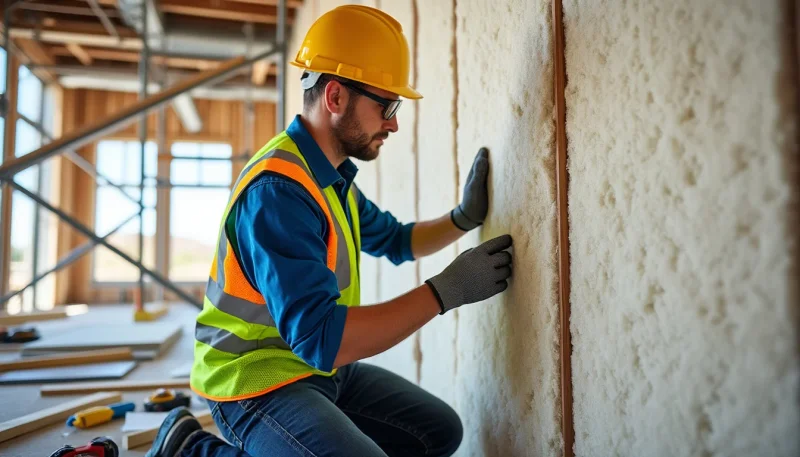
Implementing rock wool insulation requires simple yet essential precautions. Wearing gloves, safety glasses, and a respiratory mask is crucial during cutting and installation, as mineral fibers can irritate the respiratory tract and skin.
Cutting should ideally be done with a long-bladed knife or fine-toothed saw. It is important to precisely fit the panels within the framework to avoid thermal bridges. A poorly fitted panel creates a gap that largely nullifies the effectiveness of the insulation.
The vapor barrier or retarder must be installed on the warm side, that is, on the interior side. Its role is to limit the migration of water vapor into the insulation, which could cause condensation and degrade long-term performance. This step is often underestimated by novice DIYers, yet it is crucial for the durability of the installation.
Financial Aids and Return on Investment for Rock Wool Insulation
Starting an insulation project represents a significant investment, but current aid programs can considerably reduce the net cost. By 2026, several mechanisms exist to support households in their energy renovation projects.
MaPrimeRénov’ remains the central aid program. Its amount varies based on household income and the nature of the work. For attic insulation, aids can cover a substantial portion of the total cost, sometimes up to 70% for lower-income households.