
Understanding Groundwater Geothermal Systems: Operation and Costs Explained
Groundwater geothermal systems utilize stable underground water temperatures for efficient heating and cooling. Learn about their operation, costs, and regulatory considerations.
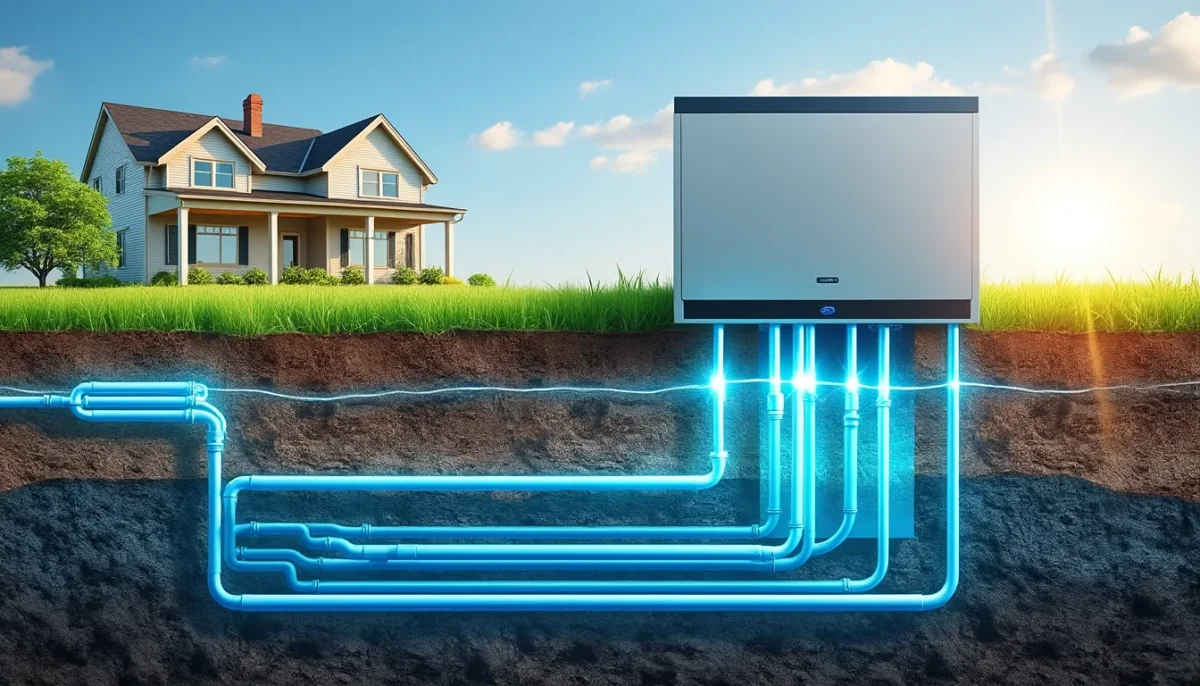
Beneath our feet, at depths of just a few dozen meters, lies a significant thermal resource that remains largely unknown to the general public: groundwater aquifers. These underground reservoirs of freshwater maintain a stable temperature ranging from 10 to 14 degrees Celsius year-round, making them a remarkably reliable and renewable energy source. Groundwater geothermal systems utilize this thermal consistency to power efficient heating and cooling systems in both residential and commercial buildings. With rising energy costs and increasing climate objectives, there is a growing interest among homeowners eager to make sustainable investments. It is essential to understand the actual operation, technical constraints, and overall costs before making such a commitment.
- Groundwater geothermal systems tap into subterranean water for renewable heating and cooling.
- The principle relies on an open loop system with at least two boreholes: a production well and a reinjection well.
- Installation costs typically range from 15,000 to 35,000 euros, depending on terrain configuration and required capacity.
- Significant financial aids are available to reduce out-of-pocket expenses, including MaPrimeRénov’ and zero-interest eco-loans.
- The efficiency is exceptional: for every 1 kWh of electricity consumed, the system can deliver up to 4 to 5 kWh of heat.
- Strict regulatory constraints govern the drilling and reinjection processes, particularly to protect water resources.
Groundwater Geothermal Systems: Understanding the Open Loop Principle
Groundwater geothermal systems are categorized as low-energy systems. Unlike horizontal collectors buried in gardens or closed vertical geothermal probes, this system directly utilizes the water present in the ground without an intermediary synthetic heat transfer fluid.
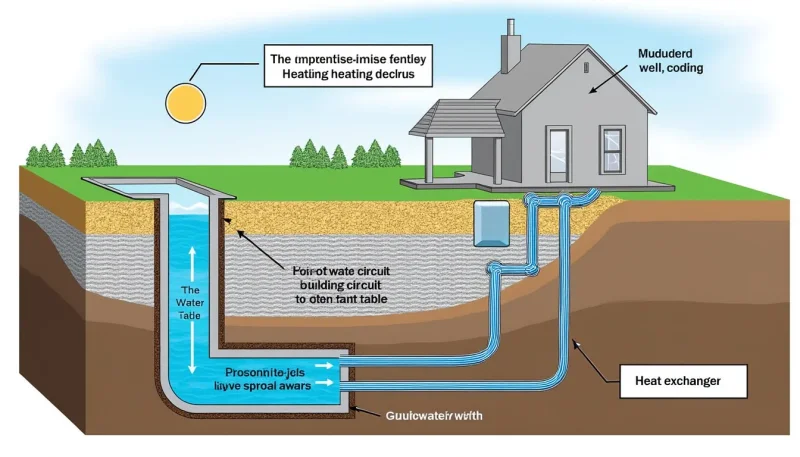
The operation is based on an open loop system: water is extracted from a primary borehole, known as the production well, passes through a heat exchanger integrated with a water-to-water heat pump, and is then reinjected into the ground via a second borehole, the reinjection well. This design ensures the aquifer remains continuously replenished without water loss.
A key feature of this system is its ability to harness a remarkably stable underground temperature. Throughout the year, the groundwater in mainland France remains between 10 and 14 degrees Celsius. This thermal stability distinguishes groundwater geothermal systems from other solutions, as they are unaffected by cold snaps or summer heatwaves.
For instance, consider a 150 m² home located in the Paris region, where the aquifer is accessible at a depth of 20 meters. The water-to-water heat pump extracts thermal energy from the groundwater, raising the temperature to between 45 and 55 degrees for underfloor heating before returning the slightly cooled water back to the aquifer. In the summer, the system can also operate in cooling mode by simply reversing the thermodynamic cycle.
While the principle is straightforward, it requires a thorough hydrogeological study beforehand. This study must verify that the aquifer is sufficiently productive, that its chemical quality is compatible with the equipment, and that local regulations permit this type of exploitation. Thus, this is not a solution to be improvised; the involvement of a specialized consulting firm is essential.
Key Steps in Installing a Groundwater Geothermal System
Installing a groundwater geothermal system is not a spontaneous process. The procedure follows a strict sequence that directly impacts the future performance of the installation. Each step is crucial, and neglecting any of them can jeopardize the entire project.
Hydrogeological Feasibility Study: A Non-Negotiable Step
Before any drilling, a hydrogeological study must be conducted by a specialist. This analysis determines the depth of the aquifer, its exploitable flow rate, chemical quality, and long-term stability. Some aquifers may have high concentrations of iron or limestone, which can cause deposits in the heat exchangers and diminish the system's efficiency.
This study relies on local geological data, sometimes including a test borehole, and results in a report that serves as the foundation for sizing the installation. Without it, there is a real risk of investing in an underperforming or technically incompatible system.
Drilling and Installation of Wells
Once feasibility is confirmed, drilling work can commence. Generally, two distinct wells are necessary: the extraction well, from which water is drawn, and the reinjection well, positioned downstream hydrologically to avoid thermal short-circuiting. The distance between the two wells depends on the flow rate and soil characteristics.
The drilling itself is carried out by a specialized company using appropriate equipment. The depth varies by geographic location but typically ranges from 15 to 80 meters. The wells are then equipped with submersible pumps and filtration systems to protect surface equipment.
Installation of the Water-to-Water Heat Pump
The heart of the system is the water-to-water heat pump, located inside the building. It connects to the home's hydraulic circuit (underfloor heating, low-temperature radiators) on one side and to the geothermal wells on the other. Its sizing must exactly match the thermal needs of the home, calculated from a precise thermal assessment.
A well-sized system can achieve a Coefficient of Performance (COP) between 4 and 5, meaning that for each kilowatt-hour of electricity consumed, the pump produces up to five kilowatt-hours of heat. This efficiency significantly surpasses that of a conventional boiler or even an air-to-air heat pump.
Costs of a Groundwater Geothermal Installation: What the Estimate Really Includes
The cost of a groundwater geothermal system is often seen as a major barrier. However, a comprehensive financial analysis shows that the initial investment should be viewed in light of the long-term savings and available financial aids.
The overall budget for an installation can be broken down into several distinct components, which are crucial to identify clearly to avoid unpleasant surprises.
- Hydrogeological study: between 1,500 and 3,000 euros, depending on the complexity of the terrain.
- Drilling of the two wells: between 5,000 and 15,000 euros, depending on depth and soil type.
- Water-to-water heat pump: between 6,000 and 12,000 euros for a standard individual home.
- Hydraulic circuit and emitters: between 3,000 and 8,000 euros if additional work is needed.
- Administrative procedures and connections: between 500 and 2,000 euros.
In total, a complete installation for an average-sized single-family home represents an investment between 15,000 and 35,000 euros. While this figure may seem high compared to a condensing boiler, it is important to factor in the annual energy savings, which can reach 60 to 70% on heating bills.
Financial aids play a crucial role in the economic equation. MaPrimeRénov’, energy savings certificates, and zero-interest eco-loans can significantly reduce the remaining costs. For eligible households, the amount of subsidies can cover between 30 and 50% of the total cost, resulting in a return on investment period of 8 to 12 years, depending on configurations.
It is also worth noting that the lifespan of the system is particularly long: the wells can last over 50 years, while the heat pump may operate for 20 to 25 years with regular maintenance. This longevity grants this type of installation an overall profitability that is hard to match with other heating solutions.
Regulation and Technical Constraints to Anticipate
Groundwater geothermal systems are subject to a strict regulatory framework that all project proponents must understand before committing. This normative rigor is justified, as the exploitation of groundwater resources concerns a common, precious, and sometimes fragile resource.
Declaration Obligations and Necessary Authorizations
In France, any drilling for geothermal purposes is governed by the Mining Code and the Environmental Code. Depending on the depth and flow rate, the project may require a simple declaration at the town hall or a prefectural authorization. For low-flow installations (less than 80 m³/h), the procedure is generally simplified, but it remains mandatory.
It is imperative never to commence work without fulfilling these formalities. An undeclared installation exposes the owner to administrative penalties and the obligation to restore the land at their own expense. This is not just a matter of administrative compliance; it is also a protection for the project itself.
Constraints Related to Groundwater Quality
Not all aquifers are exploitable without caution. Water high in iron, manganese, or limestone can cause deposits and clogging in the heat pump exchangers, reducing performance and increasing maintenance costs. Water treatment systems can be installed upstream to mitigate this issue, but they represent an additional cost to anticipate.
Moreover, the reinjection of water into the aquifer must be carried out under strict conditions to avoid affecting the overall temperature of the aquifer. A poorly positioned reinjection well can create a thermal short-circuit, gradually diminishing the system's effectiveness over the years. Thus, the design of the geothermal doublet (the two wells) requires solid hydrogeological expertise.
For those looking to deepen their eco-responsibility efforts, it can be beneficial to test their knowledge of sustainable energy and enhance their environmental awareness, particularly regarding water resources and the climate challenges that make these installations increasingly relevant.
Concrete Advantages and Real Limitations of Groundwater Geothermal Systems
While groundwater geothermal systems offer undeniable benefits, they are not a one-size-fits-all solution. A candid analysis of their strengths and limitations is essential for potential users to make informed decisions.