Do You Need Permission to Install an Aluminum Bay Window?
In most cases, replacing an existing window with an aluminum bay window of the same dimensions does not require urban planning permission. However, if the opening is enlarged or created from scratch, the rules change significantly.
In most cases, replacing an existing window with an aluminum bay window of the same dimensions does not require any urban planning permission. However, as soon as the opening is enlarged, created from scratch, or if the property is located in a protected area, the rules change significantly: a prior declaration or building permit may be necessary, under penalty of having to restore the wall at your expense. Here’s how to know exactly what applies to your situation before ordering your joinery.
The basic rule can be summarized in one sentence: any work that modifies the exterior appearance of a building is subject to a prior declaration of works, unless it falls within the exemptions listed by the Urban Planning Code. Replacing a bay window identically falls within these exemptions; enlarging an existing opening does not.
Situation
| Necessary Procedure | Description | |--------------------|-------------| | 🔄 Replacement identically (same dimension) | No permission required in ordinary areas | | 📏 Enlargement of an existing opening | Prior declaration of works mandatory | | 🚪 Creation of a new opening in facade | Prior declaration of works mandatory | | 🏛️ Building in protected area (ABF, monuments) | Architect of Historical Monuments approval required | | 🏘️ Co-ownership | General assembly agreement required in addition | | 🏠 Load-bearing wall pierced to create opening | Prior declaration + structural study recommended | | 📋 Created surface > 20 m² (extension) | Building permit mandatory |
Identical Replacement: The Simplest Case
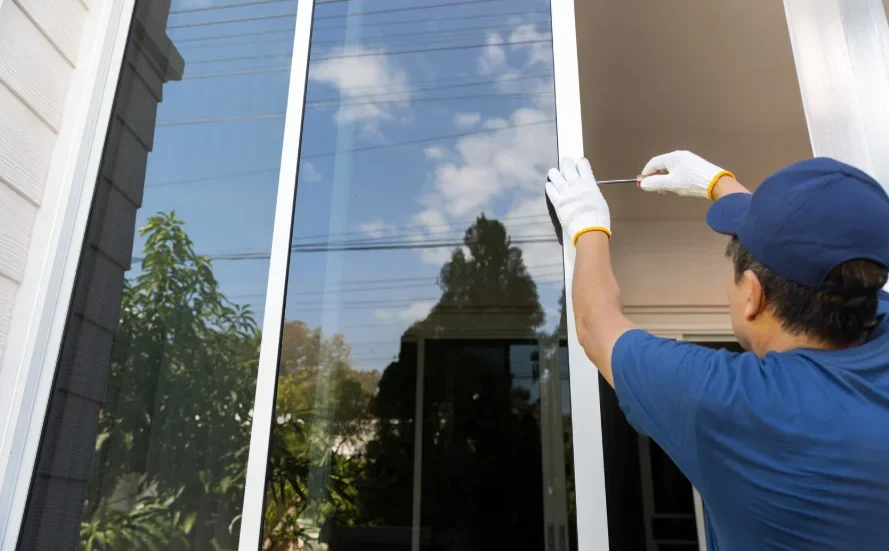
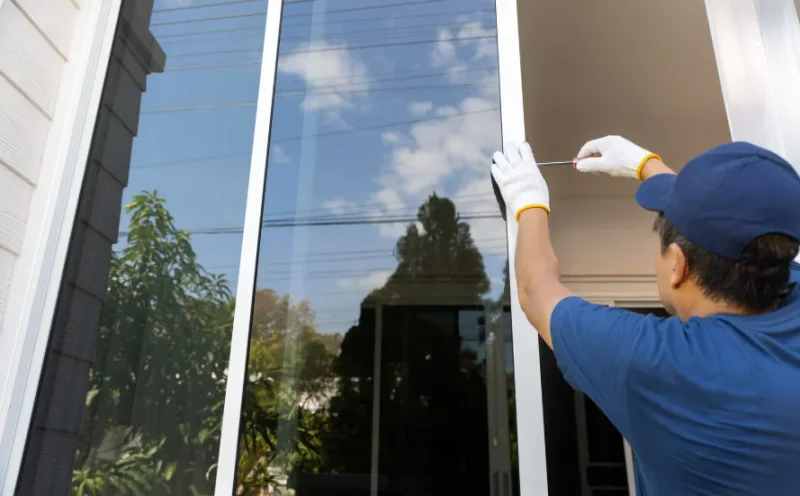
Replacing an existing bay window with a new one of the same dimensions, whether the visible material is the same or different, falls under common maintenance and renovation law. The Urban Planning Code (article R421-17) explicitly exempts from prior declaration works that do not modify the exterior appearance of a building. If your current bay measures 240 cm wide by 220 cm high and your new aluminum bay matches these dimensions exactly, you have nothing to declare in ordinary areas.
The nuance lies in the exterior appearance. Changing from a painted wooden bay to an anthracite lacquered aluminum bay technically constitutes a modification of appearance. In practice, most municipalities do not require a declaration for this type of color change on a typical single-family home, but some local urban plans (PLU) impose specific shades or prohibit certain materials. Check your municipality's PLU before placing an order if you are making a notable change in color or material.
For homeowners looking to renovate their joinery while managing their budget, ordering directly from a manufacturer is often the most economical option. A custom-made sliding aluminum bay window delivered directly from the factory avoids the margins of intermediate resellers, which can represent substantial savings on large joinery.
Prior Declaration of Works: When It Is Required
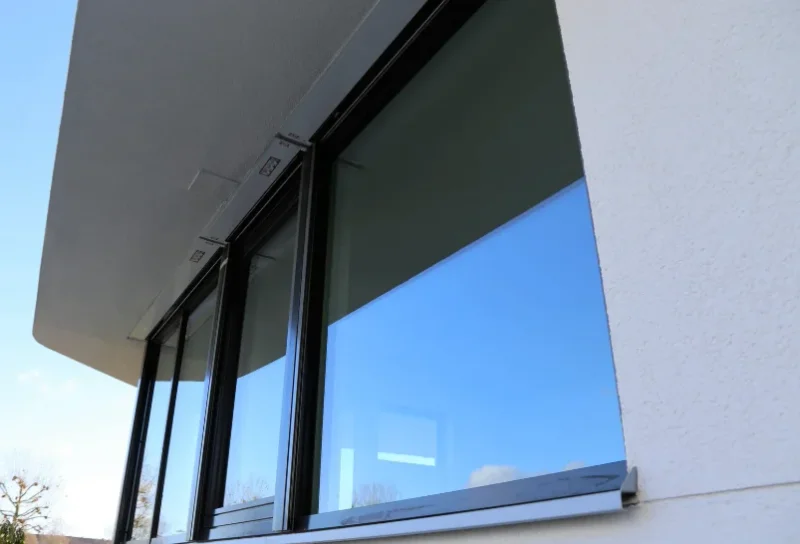
As soon as you modify the dimensions of an existing opening or create a new one, a prior declaration of works becomes mandatory. This procedure is relatively simple: it is submitted to the town hall (or online via the national portal) with a Cerfa form n°13703*09, a site plan of the land, a photo of the current facade, and a graphic document showing the future state. The instruction period is one month from the submission of a complete file, extended to two months if the building is located within the perimeter of a historical monument or in a heritage protection area.
The absence of a response within the allotted time constitutes tacit acceptance, which is useful to know: if the town hall does not respond within the regulatory time frame, your works are authorized. However, keep proof of submission and never start work before the expiration of the instruction period or before receiving explicit authorization. A tacitly accepted prior declaration engages the responsibility of the municipality in case of subsequent disputes, but you must be able to provide proof of this.
The prior declaration is valid for 3 years from its acceptance date. If you do not start the works within this period, the authorization lapses. It can be extended twice for one year each upon express request submitted to the town hall before expiration. For a standard bay window, this timeframe is rarely an issue, but it can be if your project is part of a broader renovation program that you are staggering over time.
Protected Areas: Special Vigilance Required
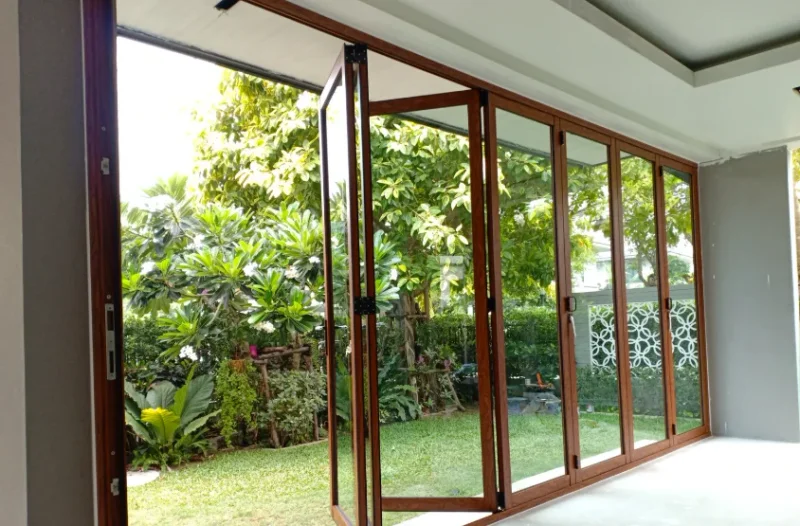
If your home is located within the perimeter of a classified or registered historical monument (generally within a radius of 500 meters around the monument), in a Remarkable Heritage Site (SPR), in a Zone of Protection of Architectural, Urban, and Landscape Heritage (ZPPAUP), or in a safeguarded sector, any modification of the exterior appearance requires prior approval from the Architect of Historical Monuments. This approval is binding: an unfavorable response blocks the urban planning authorization, regardless of the town hall's opinion.
In practice, the ABF can impose the maintenance of a certain material, a specific shade, a profile width, or a type of glazing. In these areas, aluminum is not systematically prohibited, but certain very contemporary finishes or dark colors may be refused in favor of more neutral shades or wooden joinery. Contact the ABF service in your department before selecting your bay model to avoid having to change your order after the file has been processed.
To find out if your property is affected, the urban planning geoportal (geoportail-urbanisme.gouv.fr) allows you to visualize the protection perimeters around historical monuments and the various heritage zones. Your notary or the urban planning service of your town hall can also inform you about specific constraints applicable to your plot, such as those encountered in projects affecting the appearance of a ceiling or facade in an old house, where heritage constraints sometimes apply to elements you might not expect.
Co-ownership: Rules Specific to the Collective
In co-ownership, the facade is a common part of the building, even if your apartment directly faces the outside. Any modification of the facade's appearance, including replacing a bay window with a different color or profile model, requires authorization from the general assembly of co-owners in addition to any urban planning procedures. This rule applies even if the works are entirely at your expense and only affect your unit.
The co-ownership procedure involves submitting the project to the property manager for inclusion in the agenda of the next general assembly, with a precise description of the proposed works (dimensions, material, color). Voting is generally done by a majority of article 24 (majority of present or represented votes). Starting facade works without AG authorization exposes you to a demand for restoration at the expense of the at-fault co-owner, decided by the court if necessary.
Some co-ownership regulations also impose standardized joinery models to ensure the visual uniformity of the building. In this case, your freedom of choice is very limited: you cannot install an anthracite profile if the regulation requires white or light gray. Read the co-ownership regulations carefully before any commercial steps to avoid committing to a model that the AG will reject anyway.
Piercing a Load-Bearing Wall: Authorization Is Not Enough
If creating your bay window involves piercing a load-bearing wall, the urban planning procedures are only part of the problem. From a structural standpoint, piercing a load-bearing wall requires the intervention of a structural engineering office or an architect to correctly size the lintel (IPN or reinforced concrete) that will bear the loads of the floor and roof. An undersized lintel can cause significant cracking or even partial collapse.
The structural study is not required by urban planning services as part of a simple prior declaration, but it engages the responsibility of the project owner (that is, you, if you carry out the works without an architect). In the event of a disaster related to a structural defect, your home insurance may refuse to cover damages if it establishes that the works were carried out without an appropriate technical study. For a simple piercing in a lightweight partition, this question does not arise; for a 20 cm concrete or stone wall, do not skimp on this point.
Stone houses, common in rural areas and heavily involved in opening enlargement projects, present varied structural configurations that can surprise even experienced professionals. Some walls combine large stones on the facade with a more unstable filling inside, making piercing delicate without prior bracing. The technique of opening a stone wall without bracing is not improvised, and mistakes cost infinitely more to correct than a preventive study.
What the PLU May Impose on Your Joinery Choice
The Local Urban Plan of your municipality may contain specific prescriptions regarding the materials and colors of joinery, independent of the general rules of the Urban Planning Code. Some PLUs, for example, prohibit PVC profiles on facades facing public roads, impose lacquer shades for aluminum, or limit the width of glass panes to preserve the architectural character of a neighborhood. These prescriptions apply even for identical replacements if you change materials.
Consulting the written regulations of the PLU, available on your municipality's website or on the urban planning geoportal, will give you the applicable rules for your area (UA, UB, UC according to the classification of your sector). Article 11 of the zoning regulations generally deals with the exterior appearance of constructions and the authorized materials. If the regulation seems ambiguous regarding your specific case, a request for an operational urban planning certificate (CUo) from the town hall will provide you with an official and opposable response regarding the feasibility of your project.
Outside of regulatory constraints, choosing an aluminum profile for a sliding or pocket bay window remains one of the most judicious choices for its durability, thermal performance, and low maintenance. At equal dimensions, a thermal break aluminum profile offers much better Uf coefficients than older generation steel profiles, and a longevity that far exceeds that of PVC joinery exposed to UV. Delivery times and prices vary significantly depending on whether you go through a local installer or directly from a manufacturer, a parameter to integrate from the quoting phase to avoid being pressed for time if your prior declaration imposes an instruction period.