Discover 5 Options for Your Pergola - Home Maintenance
A pergola without equipment is a beautiful structure but often underutilized. Discover five essential options to enhance your pergola experience without breaking the bank.
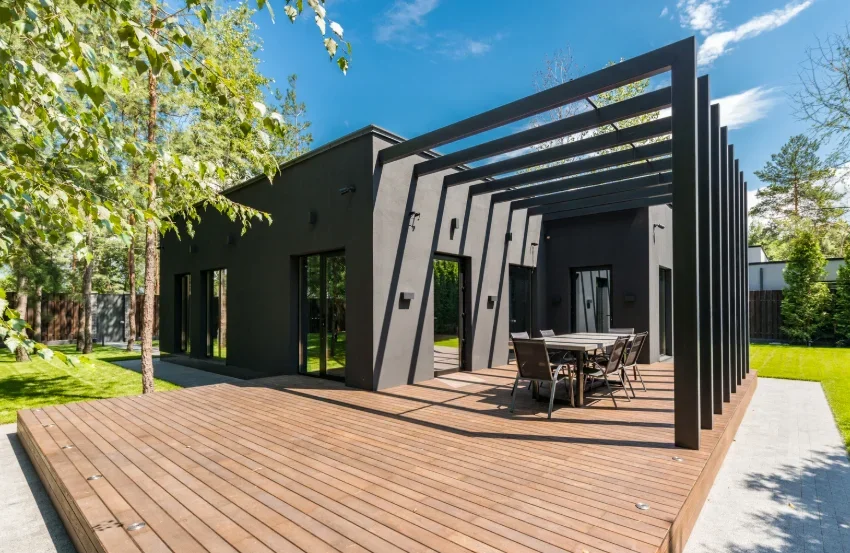
A pergola without equipment is a beautiful structure... but it remains abandoned as soon as the wind picks up or the first drops arrive. We install it with enthusiasm, and end up using it only two months a year. To truly enjoy it, often just a few well-chosen options are enough. Side screens, LED lighting, motorization, weather sensors, sliding panels: these are five pieces of equipment that radically change the experience without necessarily breaking the budget.
No need to do everything at once. Most of these options can be added gradually, over the seasons, depending on what is most lacking. The idea is to start from your actual usage and equip accordingly, rather than following a catalog to the letter.
| Option | What It Really Changes | Indicative Budget | |-----------------------|-------------------------------------------|------------------------| | 📜 Side Screens | No more wind and prying eyes | €300 to €1,500 / side | | 💡 LED Lighting | Stay outside until late | €200 to €800 | | ⚙️ Motorization | One button, and it’s done | €500 to €2,000 | | 🌧️ Weather Sensors | No need to think about it | €150 to €600 | | 🚪 Sliding Panels | From June to November without issue | €800 to €3,500 |
1. Side Screens: The Game-Changer from the First Use
This is often the first piece of equipment we regret not having planned. When retracted, side screens are completely invisible. Deployed in two seconds, they create a wall that blocks the wind, protects from neighbors' gazes, and stops glare when the sun is low in the evening. If you’ve ever given up on a terrace evening due to a cool breeze that wasn’t really cold, you know exactly what I mean.
For the choice of fabric, it depends on what you want: a water-repellent acrylic fabric lets in some light and is enough to block the wind, while an opaque fabric really isolates but closes everything off. There are also adjustable louvered screens, which allow for a middle ground. The real quality criterion is the guiding system: a guide-rail screen held along its entire height stays put even in strong winds, while a free-standing screen deforms and eventually gets torn off.
2. LED Lighting: Small Budget, Big Impact
Lighting is probably the option with the best investment/pleasure ratio. For €200 to €400 well spent, a pergola that used to shut down at dusk becomes a space where you want to linger. And unlike other equipment, it can be installed in an afternoon without special skills.
The three types that combine well: recessed spots in the beams to see what you’re eating, LED strips under the slats for soft, diffuse light, and some string lights for a more festive atmosphere. These three layers allow for modulation according to the moment's desires, where a single uniform source is unsuitable for both dining and relaxing.
The only real point of caution: the protection rating. Minimum IP65 for anything that can receive direct water projections, IP44 is sufficient for what is well protected under the cover. A €15 spot without an appropriate IP rating will tarnish after the first winter. For those who want to go a bit further in decorative lighting, the same principles of layering sources also apply indoors, as seen in LED neon decoration approaches.
3. Motorization: What We Really Use is What Requires No Effort
It may sound silly, but it’s true: a manual pergola is deployed less often. Not because it’s complicated, but because when you arrive with your arms full, it’s 32 degrees, or it looks like rain, you’re not going to struggle with a crank. Motorization simply removes that friction.
Current motors are silent (under 45 dB for good models), reliable, and available in wireless versions for pergolas without nearby electrical networks. Two criteria not to overlook: CE certification and a warranty of at least 5 years. Low-end motors tend to strain at the end of their travel, which gradually damages the fabric or slats without you noticing.
Motorization makes even more sense when integrated into a system: side screens, cover, and lighting controlled from the same remote or app. Current protocols (Zigbee, compatibility with Alexa or Google Home) allow for easy connection. It’s also worth checking your electrical contract before adding multiple motorized devices at once: the subscribed powers are not always sized accordingly.
4. Weather Sensors: Never Rush to Retract Your Screens Again
We rarely think about it until we’ve lived through the scene: you’re away, a gust is coming, and your screen is deployed. Result: twisted fabric, deformed frame, and a repair that costs much more than an anemometer would have. Weather sensors are the assurance against this situation.
The anemometer is the most important: as soon as the wind exceeds the threshold you’ve set, your equipment automatically retracts. This threshold should be set well below the manufacturer’s maximum resistance: if your screen can withstand up to 80 km/h, set the sensor to 50 or 60. There’s no need to play with the limits. The rain sensor takes over at the first drops, and the solar probe can trigger the automatic orientation of the slats or the deployment of the screens when sunlight becomes too strong.
Combined with motorization, these three sensors transform your pergola into a space that manages itself according to the current weather. You no longer think about closing; you simply enjoy. For those who enjoy automatic thermal regulation, this somewhat aligns with the philosophy of systems like cooling floors, which have their own constraints to understand before diving in.
5. Sliding Panels or Glass Walls: Transforming the Pergola into a Living Space
This is the most engaging option and by far the most transformative. With sliding glass walls, a pergola no longer closes in September: it becomes a fully-fledged room, bright, protected, usable until November in many regions. Some owners don’t even store it away anymore.
Two main families coexist. Thermal break aluminum sliding doors provide the best performance: double or triple glazing, watertight profiles, serious thermal coefficients. This is the choice for those who really want to extend the season and not feel cold as soon as it’s 12 degrees outside. Foldable tempered glass walls without a central profile are visually lighter, open completely for beautiful days, but offer less watertightness and insulation. Before making your choice, comparing technical sheets from the Alsatian specialist Caspar allows you to have concrete figures in hand rather than relying solely on commercial arguments.
One administrative point not to ignore: a pergola closed by fixed walls no longer has the same status as an open pergola. It creates living space, counts towards the ground area calculation, and may require a prior declaration or even a building permit depending on your local urban plan. The rules that apply to constructions without permits also apply here. A quick call to the town hall before ordering will save you an unpleasant surprise.
FAQ on Pergola Options
Can these features be added to an already installed pergola?
Yes, for the vast majority of them. Side screens, lighting, and motorization can be added without touching the structure. Glass walls sometimes require reinforcement of the posts if the pergola was not designed for that type of load. Only complete home automation benefits from being anticipated during construction to avoid visible cable runs.
What is the lifespan of a side screen fabric?
Between 8 and 15 years for a quality acrylic fabric (Sunbrella, Dickson, Sattler) with proper maintenance. Low-end untreated polyester fabrics last 3 to 5 years before fading and losing their waterproofing. Winter storage changes everything: a fabric left deployed from November to March sees its lifespan halved. Always retract it.
Do weather sensors work with all brands of motorization?
Not always. Somfy, Nice, and Bubendorff each have their own ecosystem. Adapters exist for certain combinations, but their reliability is uneven. The simplest solution remains to choose sensors and motors from the same manufacturer or explicitly check compatibility before purchasing.
Can the pergola be powered by solar to avoid cables?
Yes, for small consumption. Rechargeable battery motors work very well with a 10 to 20 W panel placed on the cover. Low-consumption LED lighting also works. For more power-hungry equipment like large motorized glass walls, a standard mains supply is needed.
Is a permit required to install a closed bioclimatic pergola?
It depends on your municipality and the area concerned. An open pergola is often exempt from formalities up to 20 m². Once it is closed by fixed walls, it creates living space and the rules change. Beyond 5 m² of closed area in most local urban plans, a prior declaration is required. Check with your town’s urban planning department before ordering.
Are side screens and glass walls compatible on the same pergola?
Absolutely, and it’s often the most intelligent configuration. The screens ensure a transition in mid-season to block the wind without fully closing, and the glass walls take over when temperatures really drop. Just ensure that the fastening systems of both are compatible with your structure before ordering.
Bioclimatic pergola with slats or flat roof: how to choose?
Adjustable slats are more versatile: ventilation, sun filtering, rain drainage, everything is adjustable by tilting the slats. It’s 30 to 50% more expensive than a flat roof, but the usage is incomparable. The flat roof (glass or polycarbonate) is simpler and perfectly protects from rain, but can quickly create a greenhouse effect in the middle of summer. The choice really depends on your priority: cool shade in summer or maximum protection against the elements.