Little Women: A Defense of Amy - Bradipocondriaca's Blog
A critical look at the character of Amy from Little Women, exploring her motivations, relationships, and portrayal in film adaptations.
Skip to content
My name is Amy, and I am the pretty one. Louisa May Alcott made sure to emphasize this characteristic of mine, but at least she also noted that I am quite good at painting. Until today, I had been content, but for about a month now, all the newspapers have been talking about Little Women, because the new film just came out on Netflix, which had been released in theaters right before the lockdown (shall we comment??). Greta Gerwig's version is a bit different from the others: it essentially merges the story of the four of us with that of Louisa May, starting from the beginning, when Jo/Louisa brings a story to a grumpy editor, and he, after crossing out a few hundred words, says that publication can be discussed provided, of course, that the protagonist gets married. "Or dies, that works too." It’s an interesting modification: we all know that my sister resembles Louisa a lot, but no one had made it explicit until now. I also found the editing interesting, which progresses through parallel timelines of our childhood and adulthood, only changing the filters, because evidently there was no budget to pay different actors like in the 1994 version by Gillian Armstrong, so I advise distracted viewers to pay attention to the colors: if the dominant is warm, with lots of yellows and oranges, we are still little, if the dominant is cold, we are talking about the present.
That said, I don’t want to criticize the film, which is admirable in many respects. The point is that I was given guarantees that have only been partially fulfilled. Adapting a book for the big screen is a complicated process, and not everything can be included. Besides this, every director and every screenwriter, starting from the same source text, has their own idea of the story and the characters**. My character starts off at a disadvantage**. I admit that part of it is my fault: perhaps I shouldn’t have burned Jo’s novel, which was everyone’s favorite. And it’s obvious, damn it! It’s the portrait of Louisa, who therefore had every interest in presenting her well while downplaying all her shortcomings. However, in Mervyn LeRoy's 1949 film, I am portrayed as a pompous and ignorant goose.
I am not like that. Ever since I was little, I have always had my priorities clear: I wanted to travel and marry a rich man, what’s wrong with that? My sister Meg also swooned over hats with ribbons and lace-filled dresses, but she didn’t manage to go all the way: make no mistake, she is a great wife for John Brooke, but I often catch her gazing at shop windows and sighing. Her priority was love, but she forgets it sometimes. For the most part, though, she is happy this way, so I am happy too, but we are very different.
Keep in mind that at the time it was tough to be four, without a dowry, and to get by on dreams. When I was little, few women worked, and if they did, it was always humble jobs. Widows with children were at the mercy of fate, living off the charity of kind-hearted people. You could afford to be alone only if you had a certain income, like Aunt March; otherwise, the dictat was one: find a good husband. I wanted to clarify this for all those who have defined me as opportunistic over the centuries. It’s not true, or at least, I wasn’t more so than others.
At first, I admired Jo a lot, and we have more in common than one might think: she also wanted to live on her own terms, she was indomitable, and there was no defeat that distracted her from her goal of living from writing. But in the end, she also got married. And let me confide something: I have always had the impression that that marriage was hastily put together and that no one believed in it. It was as if it had to end that way or someone wouldn’t be happy. And I’m not talking about Jo: she was self-sufficient, she just wanted to write and had the talent to do it. What happened instead? She opened a school! I’d say that’s quite far from her dreams of glory, and I’m convinced that if she hadn’t married that bore of a Professor Bhaer, she would have fared much better (I hope she doesn’t read this, anyway!). But now let’s talk about me. You’ve called me a scatterbrained opportunist, but if I had really been one, don’t you think I would have married Fred Vaughn? In the dictionary, next to the definition of “good match” was his photo: he was handsome and rich, richer even than Laurie.
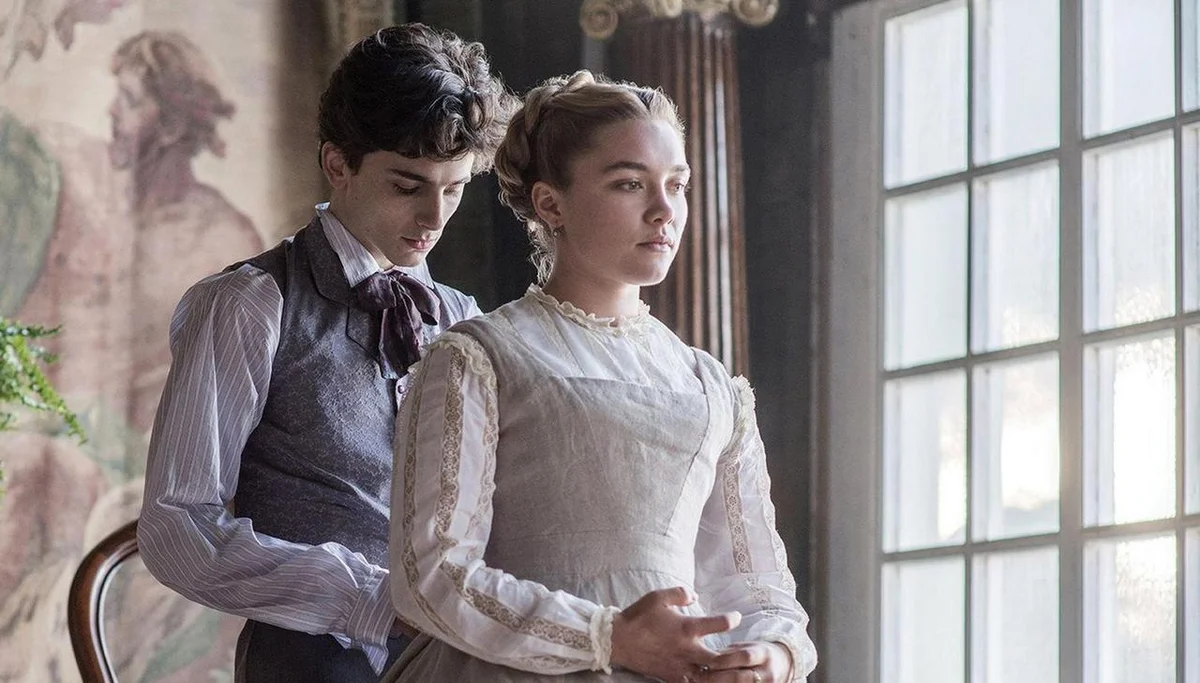
And, by the way, Greta Gerwig and Gillian Armstrong noticed something that Mervyn LeRoy overlooked, probably because he was the type of man who wouldn’t recognize love even if it knocked on his door waving an ID: I have always loved Laurie. I didn’t admit it, not even to myself, because Laurie belonged to Jo. We all thought so, and I spent my entire childhood envying her for their relationship; it was the only time I wished to be in her shoes. When I left for Europe with Aunt, I hoped to forget him, but then I found him there too, all intent on forgetting Jo and having a good time.
I pushed him to get his act together, and at that point, he must have stopped thinking of me as a child, as he always did when he came to our house just to see Jo. Some think I was a fallback, but one shouldn’t judge someone else’s love life by reading a collective book, which necessarily must silence parts of the story. For two centuries now, I see every day Laurie’s love for me. He loved Jo too, of course, but those are two different things. For her, he felt the childhood love one has for playmates: it’s beautiful, but it passes when you grow up. There was affection between them, but not passion.
I am happy with my life: I married the man I love and live the life I have always dreamed of. I didn’t have to compromise, unlike Meg and Jo, not to mention Beth, who if I start talking about her, I’ll start crying, and I don’t want to do that in front of strangers. Romantics shouldn’t hold it against me: I chose love, in the end.
In the film, I must say that this was noticeable, and I hope I have silenced some criticism. There are only two things that I don’t like: the first is having to spend my cinematic life next to Timothée Chalamet, who continues to look 15 while I look 25. All this while my sister is having a blast with Louis Garrel, while I remembered Professor Bhaer as an old owl. What I can’t stand the most, however, is looking in the mirror and seeing Florence Pugh’s face: that’s not me! I understand that the ideal of beauty has changed a bit since 1949, but try going to sleep with Liz Taylor’s features and waking up with Florence Pugh’s. Make no mistake, there are definitely worse things, but given the general trend, my question is just one: who the hell did the casting??