
KonMari vs Death Cleaning
Many believe that tidying up is simply about decluttering and creating order – yet these two approaches are based on completely different philosophies and methods.

Many believe that tidying up is simply about decluttering and creating order – yet these two approaches are based on completely different philosophies and, above all, different methods. But why compare them at all?
I often get asked which organizational method I think is the best. And I can only respond: "It depends!" What stage of life are you in? How old are you? Who do you live with? Not every method fits every lifestyle. Therefore, I will let two different approaches compete against each other to show you what is best suited for whom.
KonMari vs. Death Cleaning
“A love one wishes to inherit nice things from you. Not all things from you.”
― Margareta Magnusson, The Gentle Art of Swedish Death Cleaning
Let’s first look at the philosophy behind the two approaches:
Marie Kondo asks: "Does this item spark joy?" – a focus on self-care and positive emotions. Swedish Death Cleaning, on the other hand, poses the question: "Will anyone want this thing after my death?" Here, the responsibility towards the survivors takes center stage.
But is it really the case that young people benefit from Marie Kondo's approach, which helps gain emotional clarity? And should older individuals, who are dealing with the thought of inheritance, adopt Swedish Death Cleaning? Is it that simple? Or is it perhaps independent of age?
Swedish Death Cleaning: The Swedish Art of Conscious Letting Go
Let’s start with Swedish Death Cleaning, known in Swedish as "Döstädning." Like Marie Kondo's method (more on that later), it is much more than just a method of tidying up – it is a conscious life philosophy. This practice, developed by Margareta Magnusson*, aims to organize one’s belongings so that they do not become a burden for the survivors. The focus is on consciously letting go of things that no longer bring joy or utility in one’s life, combined with a deep engagement with one’s own life.

Unlike conventional decluttering strategies, Swedish Death Cleaning is not just about order, but about mindfulness and responsibility, both to oneself and to others. The method recommends decluttering early and continuously. This creates space for what is essential and allows for a lighter feeling in daily life. Respectful handling of mementos is paramount: only those items that truly hold significance are kept. Thus, Swedish Death Cleaning not only creates external clarity but also promotes inner peace.
Only for Old People?
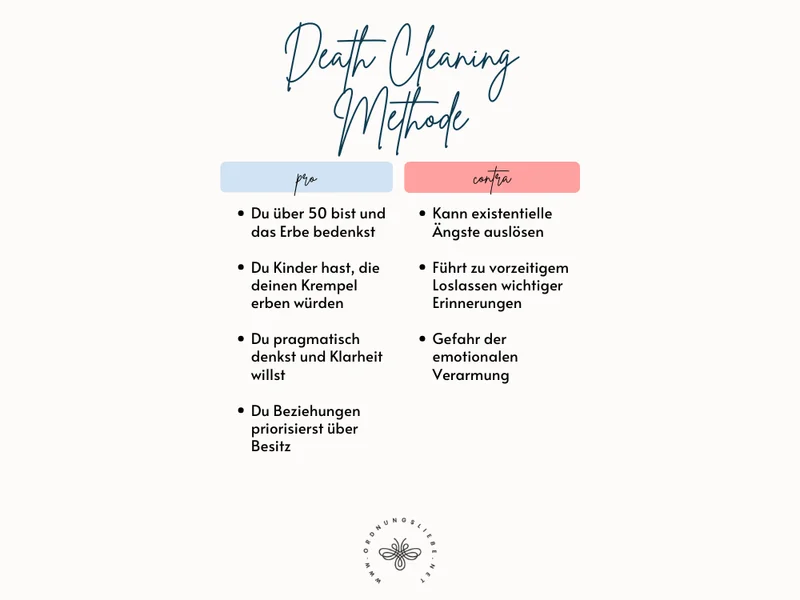
Swedish Death Cleaning is by no means just for older people! The method offers numerous benefits, especially for younger individuals, that can sustainably improve life:
Early Habit Formation
If you start consciously decluttering at a young age, you develop habits that will last a lifetime. Margareta Magnusson, the author of the groundbreaking book "The Gentle Art of Swedish Death Cleaning"*, emphasizes: "One should start as early as possible, as soon as one is old enough to think about it."
And in a time of abundance, Swedish Death Cleaning also helps younger people to consume more consciously and live more environmentally friendly. You develop a sense of what is truly important and avoid unnecessary possessions that could later become a burden.
Key Points of Swedish Death Cleaning
- Declutter early: Instead of accumulating things until the end of life, decluttering happens during one’s lifetime.
- Reduce possessions thoughtfully: Let go of everything that no longer has practical or emotional value.
- Consideration for others: The goal is to ease the burden of tidying up and decision-making for the survivors.
- Conscious living: The method encourages focusing on what is essential and being more mindful with possessions.
- Step by step: Tidying up occurs in small, well-planned steps – without stress and overwhelm.
Benefits of Swedish Death Cleaning
- Less burden in daily life and in life overall.
- More clarity and overview in one’s own home.
- Relief for relatives in serious situations.
- Promotion of a more conscious and sustainable lifestyle.
The Marie Kondo Method – More Order Through Conscious Decluttering
The Marie Kondo Method, also known as the KonMari Method, is a popular organizational system developed by Japanese tidying expert Marie Kondo*. Her approach goes far beyond mere tidying and aims to make one’s home a place that brings joy. The method is based on traditional Japanese ideas such as Wabi Sabi (侘寂) – the beauty of imperfection and transience. It is about mindfulness, awareness, and the connection between outer and inner order.
The central philosophy of Marie Kondo revolves around the question: “Does it spark joy?”.
In Japanese, she uses the term “tokimeku” (ときめく), which describes a kind of joyful excitement. It is not about what you should throw away, but about consciously choosing what may stay.

An important aspect of both methods is the engagement with memories and emotional attachments. While Marie Kondo encourages consciously parting with items that no longer bring joy, Swedish Death Cleaning prompts individuals to view their possessions from the perspective of their survivors. It is helpful to take time for conversations with family and friends to clarify wishes and expectations openly. This not only creates more clarity in dealing with one’s possessions but also fosters understanding and closeness in interpersonal relationships.
“Therefore, the best criterion for choosing what to keep and what to discard is whether keeping it will make you happy, whether it will bring you joy.”
― Marie Kondo, The Life-Changing Magic of Tidying Up: The Japanese Art of Decluttering and Organizing
Key Points of the KonMari Method
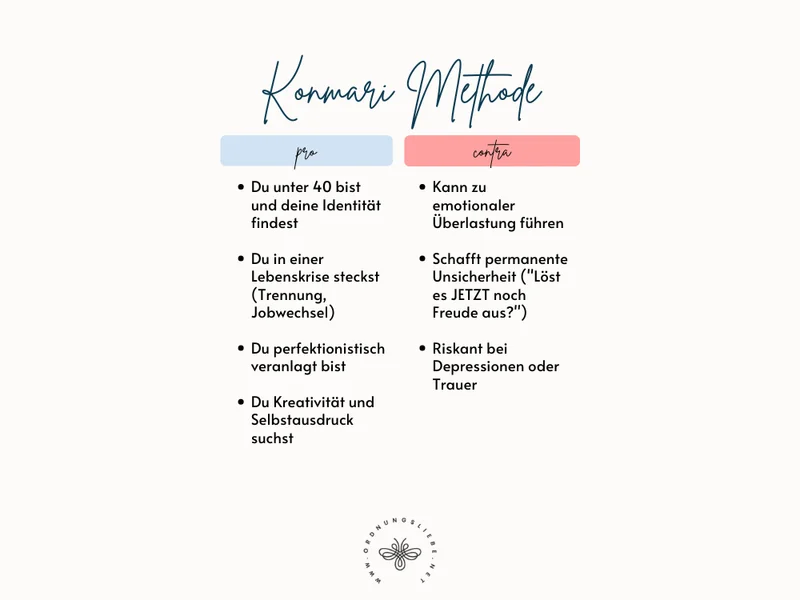
- Tidy by categories: Instead of sorting room by room, sort by categories (clothing, books, papers, miscellaneous, and mementos).
- Gather everything in one place: Collect all items of a category to maintain an overview.
- Only keep what brings joy: Hold each item and ask yourself: "Does this make me happy?" Only things that truly bring joy are kept.
- Show gratitude: Express gratitude for the items you are letting go of before releasing them.
- Proper folding technique: Clothes are folded in a space-saving and organized manner so that everything remains visible.

Benefits of the KonMari Method:
- Sustainable order instead of short-term tidying.
- Greater awareness of possessions and consumption.
- A tidy home promotes inner peace and clarity.
And Now?
The best solution? Start with Marie Kondo for your emotional well-being and beautiful order, and later switch to Swedish Death Cleaning. This way, you combine present joy with sustainable foresight.
It is also important to note that both methods are not rigid rules but flexible tools that you can adapt individually. For example, someone primarily following the principle of Swedish Death Cleaning can still experience moments of joy while decluttering – or vice versa. Ultimately, it is about developing an awareness of one’s possessions and consciously shaping them, rather than being overwhelmed by things. Only then can a tidy home be created that is both emotionally relieving and sustainable.
The Comparison: KonMari vs Death Cleaning
| Feature | Marie Kondo Method | Swedish Death Cleaning | |---------|--------------------|-----------------------| | Origin | Japan | Sweden | | Goal | Create order, promote joy in possessions | Reduce possessions, relieve survivors | | Focus | Keep everything that brings joy | Consciously reduce possessions, also out of consideration for others | | Approach | Sort by categories (clothing, books, etc.) | Gradual decluttering, often life-phase related | | Emotional Component | Show gratitude for items | Reflective letting go, even beyond death | | Handling of Mementos | Consciously choose what brings joy | Document and communicate what will be passed on | | Folding and Storage Tips | Special folding technique for clothes | Less focus on folding technique, more on reduction | | Time Frame | Intensive tidying possible in a short time | Long-term process, often spread over years | | Target Audience | People who want to organize their home permanently | People preparing their life and possessions for farewell | | Practical Everyday Tips | Schedule fixed times, avoid distractions | Work in small steps, involve family | | Philosophy | Joy and awareness in handling possessions | Consideration and serenity in handling possessions and life |
The Video on KonMari vs Death Cleaning


- As an Amazon Associate, I earn from qualifying purchases.