
Understanding the Drying Time for a 10 cm Concrete Slab: Key Insights
Learn about the drying time of a 10 cm concrete slab, including timelines, key considerations, and tips to prevent cracks. Essential for any home project involving concrete.
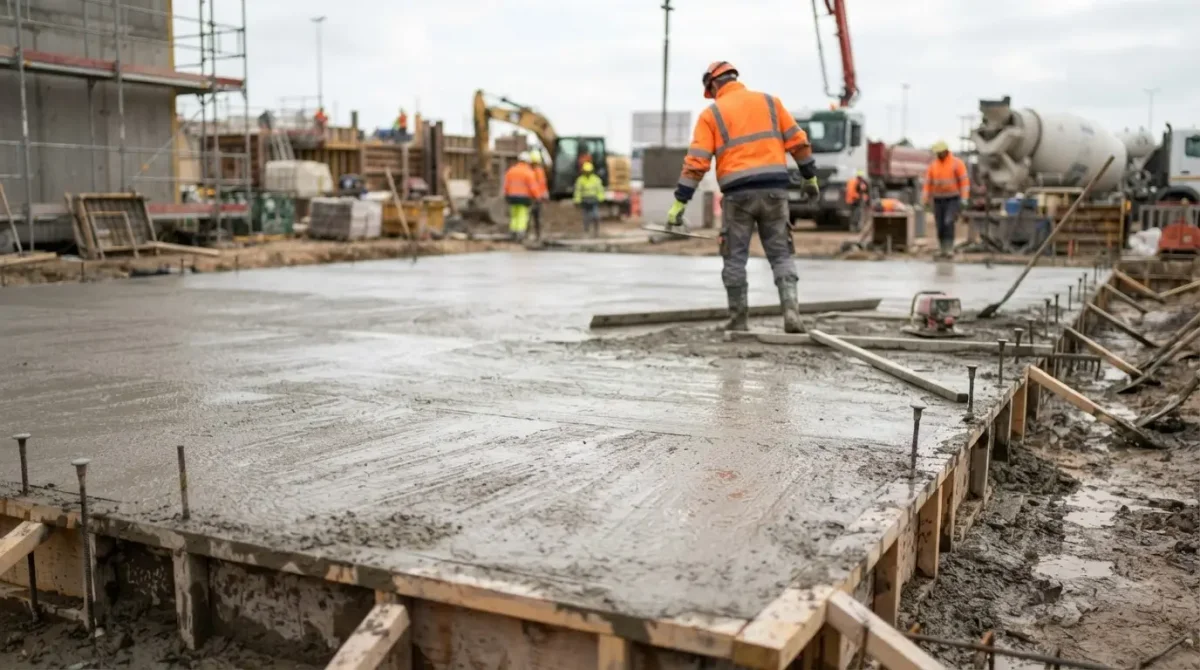
If you're curious about the drying time of a 10 cm concrete slab before walking on it, drilling, or tiling, this guide provides essential timelines, important considerations, and practical tips to prevent cracking. A helpful video illustrating the impact of thickness and weather conditions is also included.
Key Takeaways
- The critical reference point is 28 days for a 10 cm slab intended for durable finishes, tiling, or heavy loads.
- Concrete hardens quickly at the surface, but its core remains moist for a longer period, which is why waiting is necessary for demanding uses.
- Light pedestrian traffic is often possible after 24 to 48 hours, but waiting 3 days is advisable.
- To minimize cracking, the key factors are straightforward: curing, protection from sun and wind, and proper concrete mixing.
Understanding Concrete Setting, Hardening, and Drying
Many people confuse three distinct stages in the concrete process. Setting begins when cement reacts with water, causing the concrete to gradually solidify, typically within the first few hours, allowing for handling after about 24 hours.
Hardening, however, continues for a much longer duration as the chemical reaction persists within the material. Finally, drying refers to the evaporation of excess water.
This means that a slab may appear dry on the surface while still being damp internally. Therefore, the drying time of a 10 cm concrete slab cannot be summed up in just one day or even a week. The concrete gains strength over several weeks and continues to stabilize beyond that.
Remember this simple principle: hard on the surface does not equal ready for use. It is the core of the slab that determines whether you can tile, drill, or load it safely.
The Importance of 10 cm Thickness
The thickness of the slab directly affects how quickly water evaporates and how the cement reaction progresses. At 10 cm, the surface dries faster than the center. This can be misleading: a slab may look solid and firm, but its interior may still be in the hardening phase.
A common rule of thumb suggests about 1 week per centimeter for thorough drying, meaning nearly 10 weeks for a 10 cm slab.
However, this 10-week guideline applies to complete drying throughout, not standard usage. For regular applications, the reliable benchmark remains 28 days. By this time, the concrete reaches its characteristic strength, which is why finishing work is typically scheduled around this timeframe.
How Long to Wait Before Using the Slab?
Light Pedestrian Traffic
A 10 cm slab can generally support light pedestrian traffic after 24 to 48 hours. However, it is recommended to wait 3 full days for added caution. At this point, the surface has become cohesive enough to handle foot traffic, while the internal structure has yet to achieve its durable strength.
If you need to move a wheelbarrow, ladder, or bags of materials, exercise even more caution. These concentrated loads can put pressure on a small area, increasing the risk of marking the slab or initiating a crack.
Keep in mind that the slab may seem “ready” very quickly, but it is not designed to bear repeated stress too soon. Patience at this stage often prevents future repairs.
Drilling into the Slab Safely
For drilling into a 10 cm concrete slab, it's advisable to wait at least 7 to 8 days. Why this delay? Drilling generates vibrations and localized stress. If the concrete is still young, these vibrations may cause the edges of the hole to chip or create a small crack that can propagate.
It’s also recommended to use a drill bit suited for concrete and to drill without excessive force. The younger the concrete, the more you should avoid high speeds and unnecessary impacts. The goal is not just to create a hole but to maintain the integrity of the surrounding slab.
For larger projects with significant load-bearing requirements, consider reading further about permeable concrete for vehicle parking, as understanding strength and end use must go hand in hand.
Heavy Loads, Tiling, and Vehicles
For tiling, heavy loads, or vehicle traffic, the reference period is 28 days. I do not recommend shortening this phase, as the risks are not only immediate: an immature support can lead to tile detachment, localized sinking, or cracks that appear later.
Tiling, for example, requires a stable substrate and moisture levels compatible with adhesives and grouts. If the slab is still releasing a lot of water, adhesion becomes less reliable. For vehicles, the issue is even more pronounced: the weight is concentrated and repeated, meaning the slab must have had sufficient time to gain its necessary strength.
| Usage | Recommended Delay | Reason | |-----------------------------------|-------------------|---------------------------------------------------------| | Light pedestrian traffic | 24 to 48 h, ideally 3 days | The surface is firm enough, but the core remains young | | Drilling | 7 to 8 days | Limits vibrations and potential chipping around the hole | | Tiling, heavy loads, vehicles | 28 days minimum | The slab reaches its reference strength |
If your slab is intended for parking or as a technical base, keep the 28-day guideline in mind. For larger projects, I also recommend considering a guide to calculate the cost of building a house: planning a project is more effective when both technical and budgetary aspects are considered.
Drying Time for a 10 cm Concrete Slab: Key Milestones
After 2 Days
After 2 days, the slab has already changed significantly: it may appear solid, but it has not yet reached its true strength. Practically, the concrete is at about 1/3 of its final strength. This might suffice for very light traffic, but not for heavy loads or intensive work.
At this stage, avoid placing heavy objects, causing impacts, or performing any actions that could mark the surface. The concrete is still undergoing internal construction.
After 7 Days
At 7 days, the slab is much stronger. It is estimated to reach about 2/3 of its final strength. This is why drilling is considered possible starting from 7 to 8 days, though always with caution. The concrete is more resilient, but it has not yet completed its hardening process.
This milestone is useful for orientation, as it illustrates that concrete does not abruptly transition from fragile to finished. It progresses in stages, and each stage has its reasonable use.
The 28-Day Benchmark
The famous 28-day mark is not just a construction myth. It is the classic reference point for considering that concrete has achieved its adequate mechanical strength. This does not imply that it will never change again, but that its behavior has become stable enough for standard uses: tiling, traffic, heavy loads, and durable fastening.
Consider this timeframe as the true date for serious service commencement. Before this, you are waiting for hardening; after this, you can work with much greater assurance.
Core Drying and Final Strength
Core drying refers to the point when the inside of the slab has also lost its excess water. For a 10 cm slab, this can take about 10 weeks, sometimes longer depending on weather and concrete composition. Why so long? Because water does not leave the material at the same rate everywhere: the surface dries first, and then moisture migrates slowly from the center.
This is also why the final strength continues to evolve after 28 days. The slab becomes usable before it is completely dry throughout. This distinction is crucial when planning a house or outdoor project.
The right approach, therefore, is: 28 days for serious use, and longer if you seek complete core drying.
Factors Affecting Drying Time
Thickness, Mixing, and Type of Concrete
The thicker the slab, the longer the drying time. This is logical: the volume needing dehydration increases. Conversely, a concrete mix richer in cement may harden faster, as the chemical reaction is more active. However, this should not be an excuse to hasten the process indiscriminately: an overly dry or poorly mixed batch can also cause setting defects.
The type of concrete matters too. Standard concrete will behave differently than concrete prepared with an additive, which is a product added to the mix to modify its properties. An additive can improve workability, reduce certain cracks, or accelerate a hardening phase, but it must be chosen according to the actual intended use of the slab.
Temperature, Humidity, and Weather Conditions
Weather plays a significant role in the drying time of a 10 cm concrete slab. In hot and dry weather, water evaporates too quickly; in cold weather, setting slows down considerably. It is advisable not to pour concrete when the temperature of the support or air drops to 5 °C or lower, as cement hydration slows and the structure may be compromised.
Humidity also plays a decisive role. If the air is too dry, the slab loses its water before the cement has had time to react properly. The result: the surface shrinks too quickly, leading to shrinkage cracks.
Wind, Sun, and Slab Size
Wind and sun accelerate surface evaporation. This is helpful for seeing the drying process but detrimental to the final quality. On an outdoor slab, especially if exposed to direct sunlight or in a draft, the surface dries faster than the rest of the volume.
This is where the risk of cracking increases.
Size also matters: on a small slab, for example, less than 15 m², favorable weather can aid the visual process. However, I recommend not reducing the structural delay: the 28 days remain the baseline to avoid unpleasant surprises.
Why Does a Concrete Slab Crack During Drying?
The Shrinkage of Concrete
The primary cause of drying cracks is shrinkage due to water loss. This term refers to the contraction of concrete as it loses water before cement hydration is fully complete. In simple terms, the material shrinks. If this shrinkage occurs too quickly or unevenly, cracks may appear.
There is also thermal shrinkage: when the slab heats up and then cools too quickly, it experiences internal tensions. Again, concrete struggles to cope if it has not been protected. This is why the drying time of a 10 cm concrete slab must always be considered in light of daily conditions.
Excessive Heat and Rapid Evaporation
In very hot weather, with wind and direct sunlight, water leaves the surface before the slab has stabilized. The concrete ends up with a hard crust and an active core. This difference in behavior encourages microcracks, or even more pronounced cracks if drying is abrupt.
Conversely, an untimely rain or nighttime frost can also damage a young slab. The best approach is to control the environment rather than let it dictate the outcome.
What Tolerance Exists for a Concrete Slab Crack?
A fine, stable, and non-evolving microcrack may be related to normal shrinkage, but significant cracks indicate a need for further assessment.